White vinegar in laundry: when it helps and when it doesn't
In this guide
Stiff towels are the usual reason people start pouring vinegar into the washer, often on the advice of a forum thread that insists on a splash in every load. White vinegar in laundry does have real uses: it is a mild acid, and a small amount in the rinse can loosen the alkaline detergent residue that makes fabric feel crunchy and hold on to smells. It is also cheap, fragrance free and easy to rinse away.
What it is not is a detergent, a disinfectant or a cure for set in stains, and it has one dangerous partner, chlorine bleach. It can also be hard on some washing machines if you use it constantly, so the real skill is knowing how much to add, where it goes, and when to leave it on the shelf.
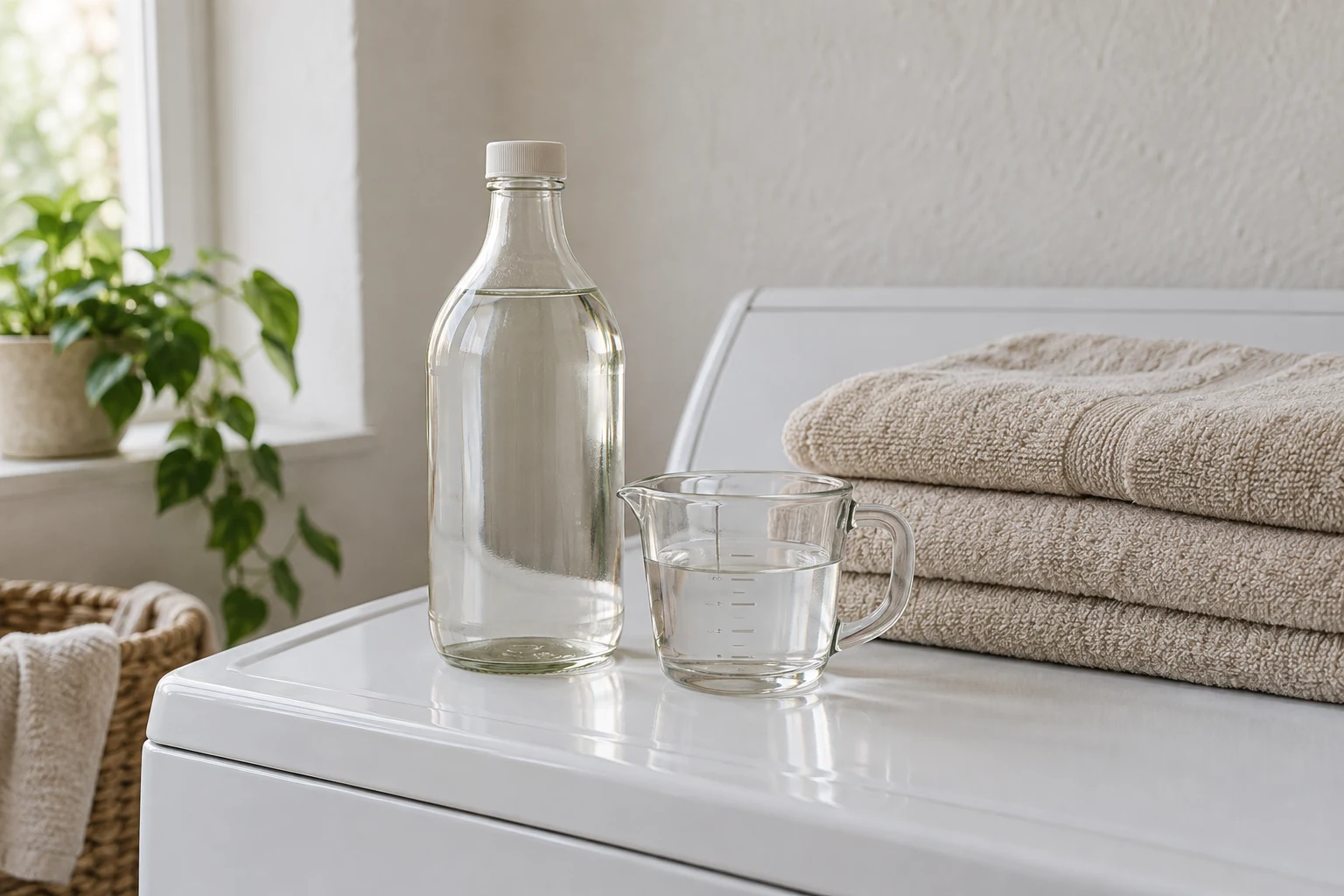
What white vinegar does in the wash
Household distilled white vinegar is a dilute solution of acetic acid, usually around 5 percent. Most laundry detergents are mildly alkaline, and so are the mineral deposits hard water leaves behind. A little acid in the final rinse helps dissolve that film, which is why vinegar can make towels feel less stiff and why some people use it as a fragrance free fabric softener. It does not coat fibers the way conventional softener does, so it will not reduce the absorbency of towels.
The limits matter just as much. Consumer Reports notes that vinegar is not very useful on stains that have already set, including food and blood, and household vinegar is not a registered disinfectant, so it is not a substitute for hot water, detergent or bleach when laundry needs sanitizing. The vinegar smell fades as the clothes dry. If fabric still smells sour afterward, the problem is usually a washer that needs cleaning or clothes that sat wet too long, not too little vinegar.
How to use vinegar in laundry, step by step
The safest routine is simple: detergent does the cleaning during the wash, and vinegar arrives later, during the rinse.
Check the load for bleach first
If the load, the drum or the bleach dispenser has had chlorine bleach in it this cycle, skip the vinegar. Chlorine bleach and acids release chlorine gas when they meet, so the two should never share a wash.
Measure about half a cup
Half a cup (120 ml) of distilled white vinegar is the usual amount for a full load in a standard machine. For a small load or a compact front loader, a quarter cup is enough. More does not soften further; it only adds acid to your machine.
Pour it into the fabric softener compartment
The softener compartment releases its contents during the final rinse, after the detergent has drained. In a front load washer this is the small section of the drawer usually marked with a flower symbol. Do not use the bleach compartment, which may hold bleach residue.
No dispenser? Add it at the rinse
In an older top loader without a softener cup, wait until the machine has drained the wash water and is filling for the rinse, then pour the vinegar into the water. A refillable softener ball that opens during the spin works too.
Dry as usual and check the result
Clothes should come out with no lingering vinegar smell once dry. If towels are still stiff, the likely cause is too much detergent; our guide to how much detergent to use explains how to cut back.
Vinegar and detergent together, or one after the other
People often ask what happens if you use vinegar and laundry detergent together in the same compartment. Nothing dangerous happens, but you work against yourself. Detergents are built to clean in slightly alkaline water, and an acid poured in at the same moment lowers the pH the detergent was designed for, so it cleans less well. That is why the answer to whether vinegar goes in before or after detergent is after: let the wash finish, then let the rinse bring the vinegar in.
Baking soda has the same problem in reverse. It is a mild base and vinegar is an acid, so mixed in one step they fizz and neutralize each other into mostly water, sodium acetate and carbon dioxide, as Houston Methodist explains. That combination is not dangerous, but it is not a stronger cleaner either. If you want both, use baking soda in the wash and vinegar in the rinse, or use them on different days; our guide to baking soda in laundry covers its side of the routine.
The mixing rules that really matter
Chlorine bleach and vinegar are the most dangerous combination in this guide. The Washington State Department of Health explains that bleach mixed with any acid, vinegar included, gives off chlorine gas, which irritates the eyes, nose and throat at low levels and can cause serious breathing problems at higher ones. The American Cleaning Institute gives the same warning about acids and about ammonia. In practice that means no vinegar in a load with chlorine bleach, no vinegar in the bleach dispenser, and a thorough rinse of any basin or garment before switching from one to the other.
Hydrogen peroxide is the other partner to keep apart. Houston Methodist notes that mixing peroxide and vinegar in the same container can form peracetic acid, which irritates the skin, eyes, throat and lungs. Oxygen bleach releases hydrogen peroxide in water, so treat it the same way: use it in the wash, and keep any vinegar for a later rinse or a different day. Our guide to using oxygen bleach explains how it works.
| Mixed with | What happens | Do this instead |
|---|---|---|
| Chlorine bleach | Releases chlorine gas | Never the same load or dispenser; rinse thoroughly between |
| Hydrogen peroxide or oxygen bleach | Can form irritating peracetic acid | Peroxide in the wash, vinegar in a later rinse or another day |
| Detergent, at the same time | Lowers the pH, so it cleans less well | Detergent in the wash, vinegar in the rinse |
| Baking soda, in one step | They fizz and neutralize each other | Baking soda in the wash, vinegar in the rinse |
Is vinegar bad for your washing machine or your clothes?
Consumer Reports reports that regular vinegar use can damage the rubber seals and hoses in some washing machines, which can lead to leaks, and that front loaders are particularly vulnerable. Some washer makers now advise against it altogether. A reasonable middle path is to use vinegar occasionally, measured, and through the softener dispenser, where it arrives diluted in rinse water, rather than pouring it neat into the drum every week. Read your washer manual; if it tells you not to use vinegar, follow it.
On clothes, a half cup in a full rinse is very dilute and is not known to harm ordinary washable cotton, linen or synthetics. The practical exceptions are garments whose label calls for dry cleaning, and wool and silk, which rarely benefit: a plain water rinse with a mild wool detergent does the job there, as our guide to washing wool explains. Never pour undiluted vinegar straight onto a colored garment without testing an inside seam first.
Vinegar for odors, soaking and towels
For sweaty gym clothes or a musty smell, a short soak can help before a normal wash. Mix about one cup of white vinegar into a basin or sink of cool water, submerge the clothes, and leave them for 30 minutes to an hour, then wash them as usual with detergent. Soaking clothes in vinegar overnight rarely adds anything and leaves them sitting wet for hours. If the smell returns right after washing, work through the causes in our guide to getting smells out of clothes.
Towels are where vinegar earns its reputation. The towel maker Peacock Alley suggests a first wash of new towels with half a cup of white vinegar and no detergent, vinegar in the rinse about once a month instead of fabric softener, and a cup of vinegar with no detergent to strip buildup from towels that have gone stiff. Our guide to washing towels puts that into a full routine.
Common mistakes
Adding vinegar to a bleach load
This is the one mistake that can hurt you. Chlorine bleach and vinegar release chlorine gas. Keep them in separate washes and rinse the drum or basin in between.
Pouring it in with the detergent
Acid added at the start of the wash weakens the detergent. Put vinegar in the softener compartment so it arrives in the rinse.
Using it in every single load
Regular use can wear rubber seals and hoses in some machines, and most loads do not need it. Keep vinegar for stiff towels, odor problems and the occasional residue clearing rinse.
Questions people ask
Is it okay to mix white vinegar and laundry detergent?
It is safe, but not useful in the same step, because the acid works against the detergent. Add detergent to the wash and vinegar to the fabric softener compartment so it enters during the rinse.
Where do I put vinegar in a front load washing machine?
Use the fabric softener compartment in the detergent drawer, usually marked with a flower symbol. It releases during the final rinse. Do not use the bleach compartment or pour vinegar straight into the drum.
Can vinegar replace fabric softener?
It can soften the stiffness caused by detergent and hard water residue, and it leaves no coating, which is why many people prefer it for towels. It will not give the slippery feel or scent of conventional softener. Half a cup in the softener compartment is enough.
Does vinegar disinfect laundry?
Household vinegar is not a registered disinfectant and should not be relied on to sanitize laundry after illness. Use the hottest water the care label allows and a bleach suited to the fabric instead.
Can I use apple cider vinegar instead?
It is better to stick with distilled white vinegar. Apple cider vinegar is colored and may tint light fabrics, and it offers no cleaning advantage in the rinse.
Sources and further reading
References used for this guide. Each opens the original page in a new tab.
- Consumer Reports: things you should never clean with vinegar, including washing machines Opens in a new tab
- Houston Methodist: how natural cleaning products work and which ones not to mix Opens in a new tab
- Washington State Department of Health: dangers of mixing bleach with cleaners Opens in a new tab
- American Cleaning Institute: how to use bleach Opens in a new tab
- Peacock Alley: how to wash and dry towels Opens in a new tab
Keep reading
Washing and ironing
Baking soda in laundry: what it can and can't do
How to use baking soda in laundry: how much to add, where to put it, what it does for odors and stiff towels, and why it cannot replace detergent on its own.
Washing and ironing
How to wash towels so they stay soft
How to wash towels in a washing machine: the right temperature, less detergent, no softener, when vinegar helps, and how to fix towels that smell or feel stiff.

Washing and ironing
How to get smell out of clothes
How to get smell out of clothes, whether it is sweat, a musty washer smell or smoke: airing, better washing, careful use of baking soda and vinegar, and prevention.
Washing and ironing
How much laundry detergent to use per load
How much detergent to use in a washing machine: reading cap lines, pods and powder, adjusting for load size, soil and hard water, and the signs you use too much.
Washing and ironing
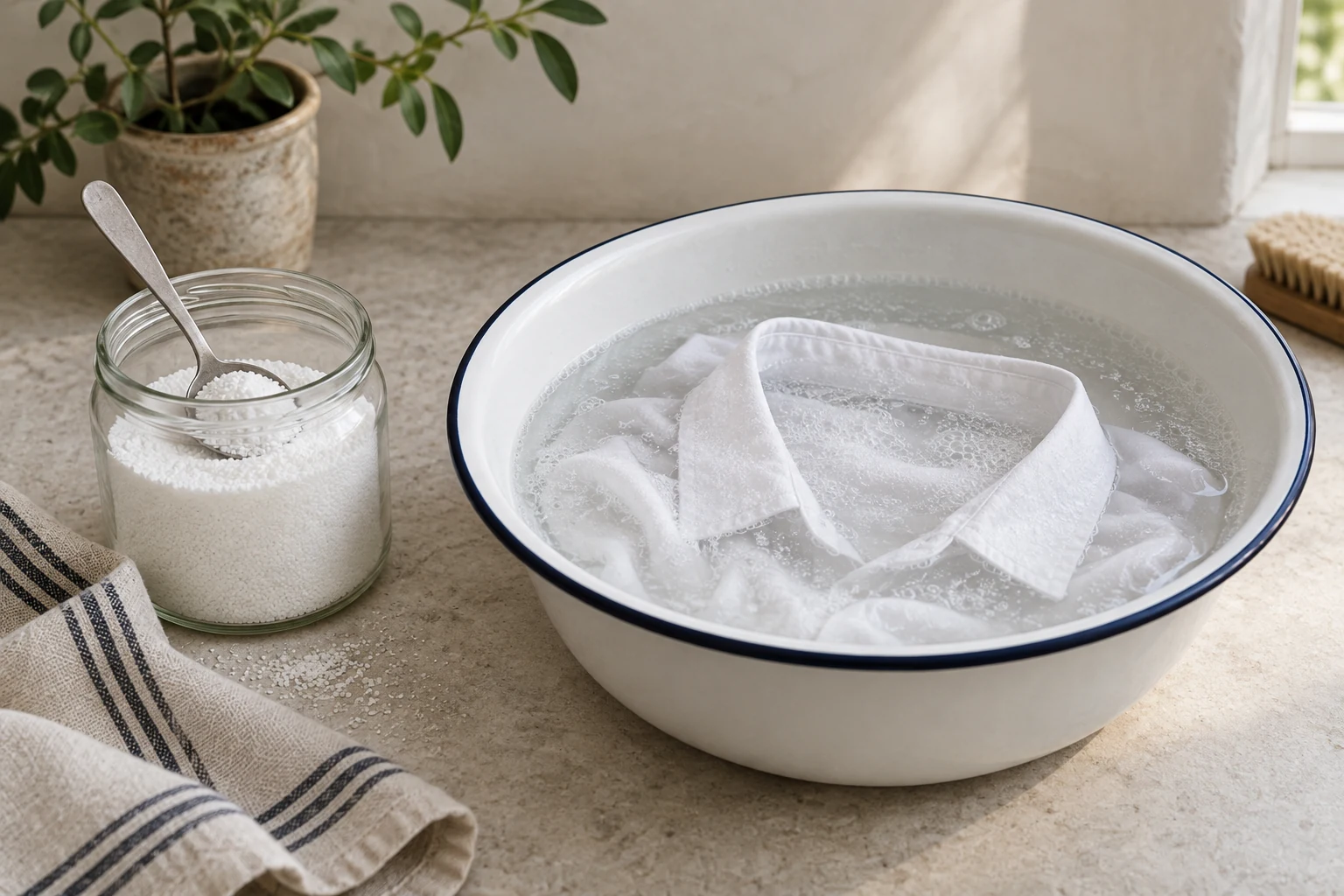
How to use oxygen bleach (sodium percarbonate) on clothes
What sodium percarbonate is, how oxygen bleach powder works, how to use it in the wash or as a soak on whites and colors, and the safety rules that matter.