Oxford vs derby shoes: the difference and when to wear each
In this guide
Two pairs of dark brown lace ups sit side by side in the store, same leather, same shape of toe, and one is labeled oxford and the other derby. They look almost identical at arm's length. The oxford vs derby shoes question matters more than it seems, because the small difference in how the laces are set changes how formal the shoe looks and how well it fits your foot.
Here is how to tell them apart in a few seconds, which one suits which occasion, how each fits different feet, and where brogues, wingtips and bluchers belong in the picture.
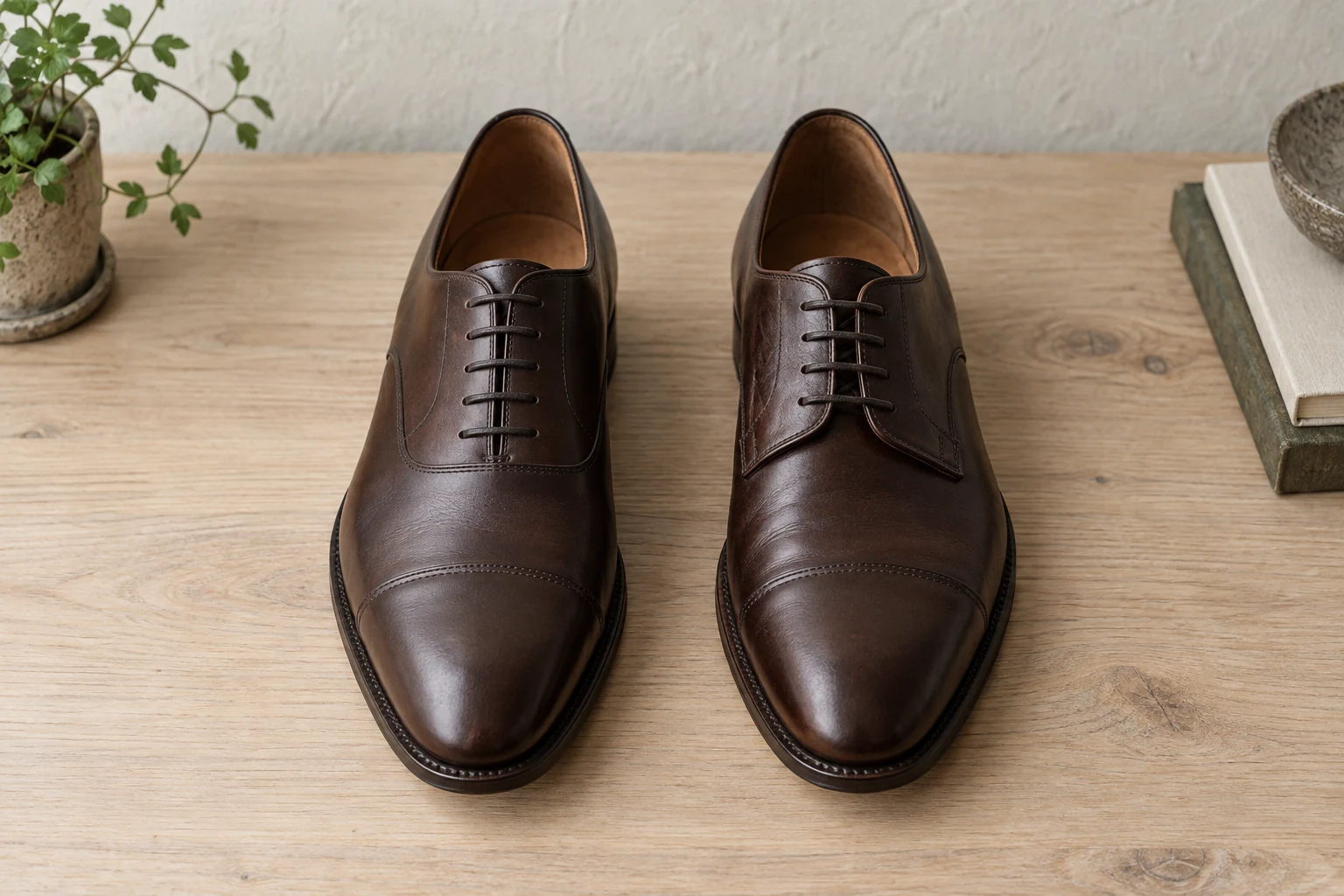
Oxford vs derby shoes: it is all in the lacing
Every lace up shoe has a vamp, the front piece that covers your toes and the top of your foot, and quarters, the side and back pieces that carry the eyelets. On an oxford, the quarters are stitched underneath the vamp. Crockett & Jones, the Northampton shoemaker, calls this closed lacing: the tongue is a separate piece sewn beneath, and the two eyelet panels meet close together, so the laced shoe shows a neat V at the base of the lacing and very little tongue.
On a derby, the quarters are stitched on top of the vamp instead. The eyelet panels are flaps that sit over the shoe and can spread apart, which is called open lacing. When a derby is laced, you usually see a gap between the flaps with the tongue showing beneath, and the laces look more prominent across the top of the foot.
To tell them apart, look at the bottom of the lacing. If the eyelet panels disappear under the front of the shoe in a closed V, it is an oxford. If they sit on top like two separate tabs with their lower edges stitched onto the vamp, it is a derby. Toe shape, color and decoration tell you nothing either way.
Which is more formal, and why
The closed lacing of an oxford gives a smooth, unbroken line across the top of the foot, which is why it has long been the standard shoe for business and formal dress. Crockett & Jones describes the oxford as the most formal style and the black oxford as the first pair of shoes a man should own. A plain black cap toe oxford, with a single straight line of stitching across the toe, goes with every dark suit and is correct at interviews, funerals and formal weddings; patent or highly polished black oxfords are the traditional choice for the black tie dress code.
The derby is the more relaxed of the two, and the same maker calls it perhaps the most versatile shoe style, bridging smart and smart casual. That does not make it wrong with a suit. A dark brown or black derby in smooth leather looks at home with most business suits, and it suits heavier cloths like flannel and tweed particularly well. Where the derby shines is the wide middle ground: chinos, sport coats, business casual and even dark jeans, especially in grain leather, suede or with a thicker sole.
As a rule of thumb, the more formal the occasion, the more you should lean toward a black, plain oxford; the more relaxed, the more freedom you have with derbies, brown shades and texture. Between those poles, most offices will not notice which one you wear, as long as the shoes are clean and polished.
Fit: why a derby suits a high instep
The construction also changes the fit. Because a derby's eyelet flaps are free to open wider, the shoe can adjust to a high instep, a thick foot or a wide foot. Gentleman's Gazette notes that open lacing gives more latitude in fitting, and it traces the style to the Prussian general von Blücher, who is said to have wanted boots his soldiers could put on quickly and adjust. If oxfords always feel tight across the top of your foot even in the right length, try a derby before you try a bigger size.
An oxford is less forgiving. Its closed lacing can only open as far as the stitching allows, so on a high instep the eyelet panels spread into a wide gap and the laces strain. On a very low, slim instep, the panels may close completely with room to spare, a sign the shoe is too roomy over the top. When you try on oxfords, lace them snugly and look for the two panels sitting close and roughly parallel. If they splay into a wide V, the shoe is fighting your foot.
| Feature | Oxford | Derby |
|---|---|---|
| Lacing | Closed, quarters stitched under the vamp | Open, quarters stitched on top of the vamp |
| Formality | The most formal lace up | Bridges smart and smart casual |
| Best with | Dark suits, interviews, funerals, black tie | Suits in flannel or tweed, chinos, sport coats, dark jeans |
| Fit | Less forgiving over a high instep | Adjusts to a high instep or a thick foot |
Where brogues, wingtips and bluchers fit in
Brogues vs oxfords is a common confusion, but the two words describe different things. Broguing is decoration: rows of small punched holes and a serrated edge along the seams of the leather. It can appear on an oxford or a derby, so a shoe can be a brogue oxford or a brogue derby. Crockett & Jones notes that brogues were historically associated with rugged country wear, which is why more perforation reads as less formal.
The main levels of decoration have names. A quarter brogue has perforations along the toe cap seam only; a semi brogue adds a decorative medallion pattern on the toe; a full brogue has a toe cap shaped like a W, with long wings running back along the sides. In the United States, that full brogue is usually called a wingtip, so brogues vs wingtips is really a question of how much decoration, with wingtips at the most decorated end.
Blucher is the other term you will see, especially in American shops, where it often simply means a derby. Gentleman's Gazette draws a finer technical line: on a blucher, the eyelet tabs are separate small pieces sewn onto a one piece vamp, while on a derby the quarters themselves are sewn over the vamp. Both have open lacing and sit at the same level of formality, so for dressing purposes oxford vs blucher is the same question as oxford vs derby.
What to wear with each
For a funeral or a conservative interview, a black oxford with little or no decoration is the reliable choice. For navy and gray suits in most offices, dark brown oxfords or smooth derbies both work; for a lighter suit or a summer wedding, brown derbies or semi brogues feel easier. Our guide to shirts and ties for a navy suit covers which shoe colors go with which suit.
Once the jacket comes off or the trousers turn into chinos, derbies take over. Brown derbies in grain leather or suede work with chinos, flannel trousers and dark jeans, and a brogue derby with a thicker sole is one of the most useful shoes for a smart casual wardrobe. Whatever you choose, match your belt to the shoe, and keep leather shoes in good order with our guide to polishing shoes. For a clean look on oxfords, the straight bar method in our guide to lacing shoes shows no diagonal crossings.
Oxford and derby shoes for women
The same construction applies to women's shoes, although shops often use oxford loosely for almost any flat lace up. If you are shopping for oxford shoes for women, check the lacing the same way: closed means a sleeker, dressier shoe, open means more adjustability and a sturdier look. Many women's derbies come on chunky or platform soles, which lean casual, while slim black oxfords and two tone black and white styles have a more tailored, vintage feel.
Oxfords and derbies look particularly good with tailored trousers, cropped or ankle length pants that show the shoe, and wide leg trousers that clear the laces; our guide to styling wide leg trousers has more ideas. With skirts and dresses, a slim oxford with a thin sock or bare ankle keeps things light, while a heavier derby suits wool skirts and cooler weather.
Common mistakes
Assuming any brogue is casual
A quarter brogue oxford in black or dark brown is still a business shoe. Formality drops as decoration increases, but the lacing and color matter as much as the holes.
Sizing up when oxfords pinch across the top
If the length is right but the lacing gapes or strains, the problem is instep height, not size. A derby in your usual size will usually fit better than an oxford half a size up.
Wearing chunky derbies with a slim formal suit
A thick soled, heavily textured derby looks heavy under slim suit trousers. Save rugged derbies for casual trousers and heavier cloths, and choose a sleeker shoe for fine worsted suits.
Questions people ask
Can you wear derby shoes with a suit?
Yes. A smooth black or dark brown derby works with most business suits, and derbies suit flannel and tweed particularly well. For the most formal occasions and black tie, an oxford is the more traditional choice.
Is a blucher the same as a derby?
For practical purposes, yes: both have open lacing and the same formality. Technically, a blucher has its eyelet tabs sewn onto a one piece vamp, while a derby has the whole quarters sewn over the vamp.
Which is better for wide feet or a high instep?
Usually the derby. Its open lacing lets the eyelet flaps spread to accommodate a taller or wider foot, while an oxford's closed lacing has less room to adjust.
Are oxfords or derbies better for a wedding?
For a black tie or formal evening wedding, black oxfords. For a daytime, outdoor or relaxed wedding in a suit, brown oxfords or derbies both look right, and derbies are often more comfortable for a long day on your feet.
Can you wear oxford shoes with jeans?
Yes, if the oxford leans casual: brown leather, suede, or a brogued style with a slightly sturdier sole looks natural with dark, well fitting jeans. A sleek black cap toe oxford is cut for suits and tends to look stiff with denim. If you want one lace up for jeans and chinos, a derby is the easier choice, and our guide to types of dress shoes shows where loafers and monk straps fit in.
Sources and further reading
References used for this guide. Each opens the original page in a new tab.
Keep reading
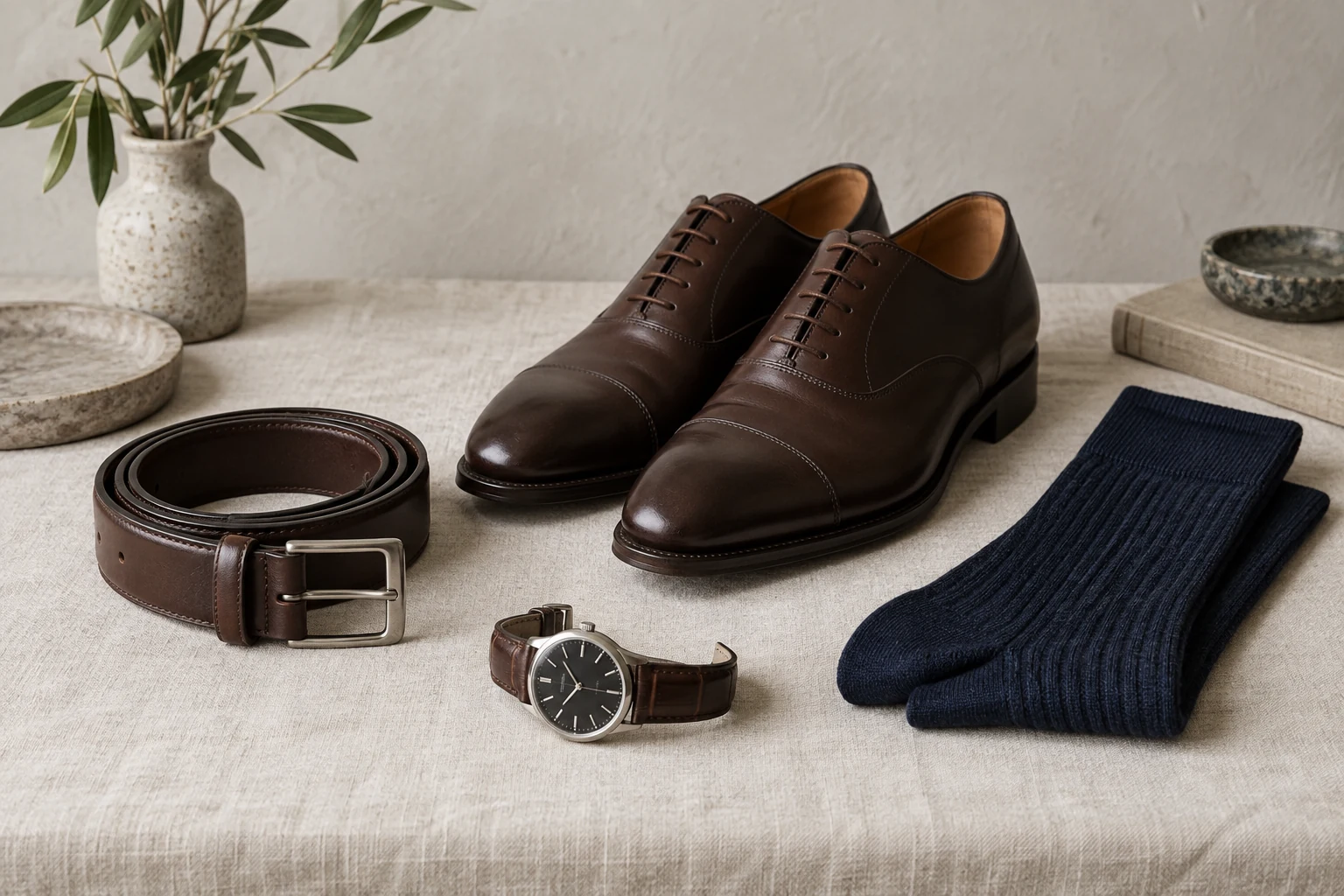
Suits and tailoring
How to match your belt, shoes and socks
How to match belt and shoes by color and finish, which buckle goes with your watch, why socks follow the trousers, and when casual outfits let you relax the rules.
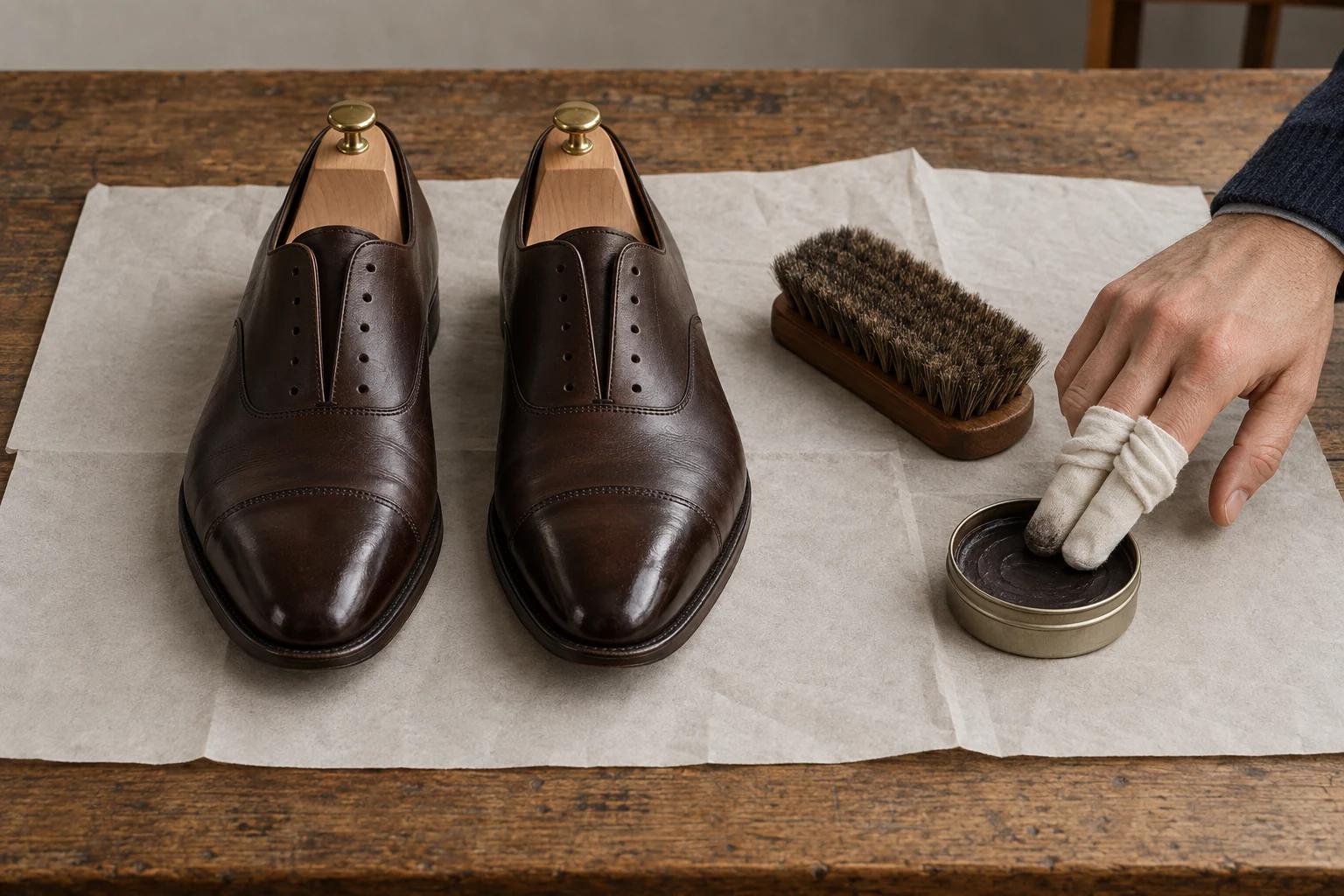
Shoes and jewelry
How to polish shoes at home, step by step
How to polish leather shoes at home: clean and condition first, use cream for color and wax for shine, buff properly, and keep the shape with shoe trees.
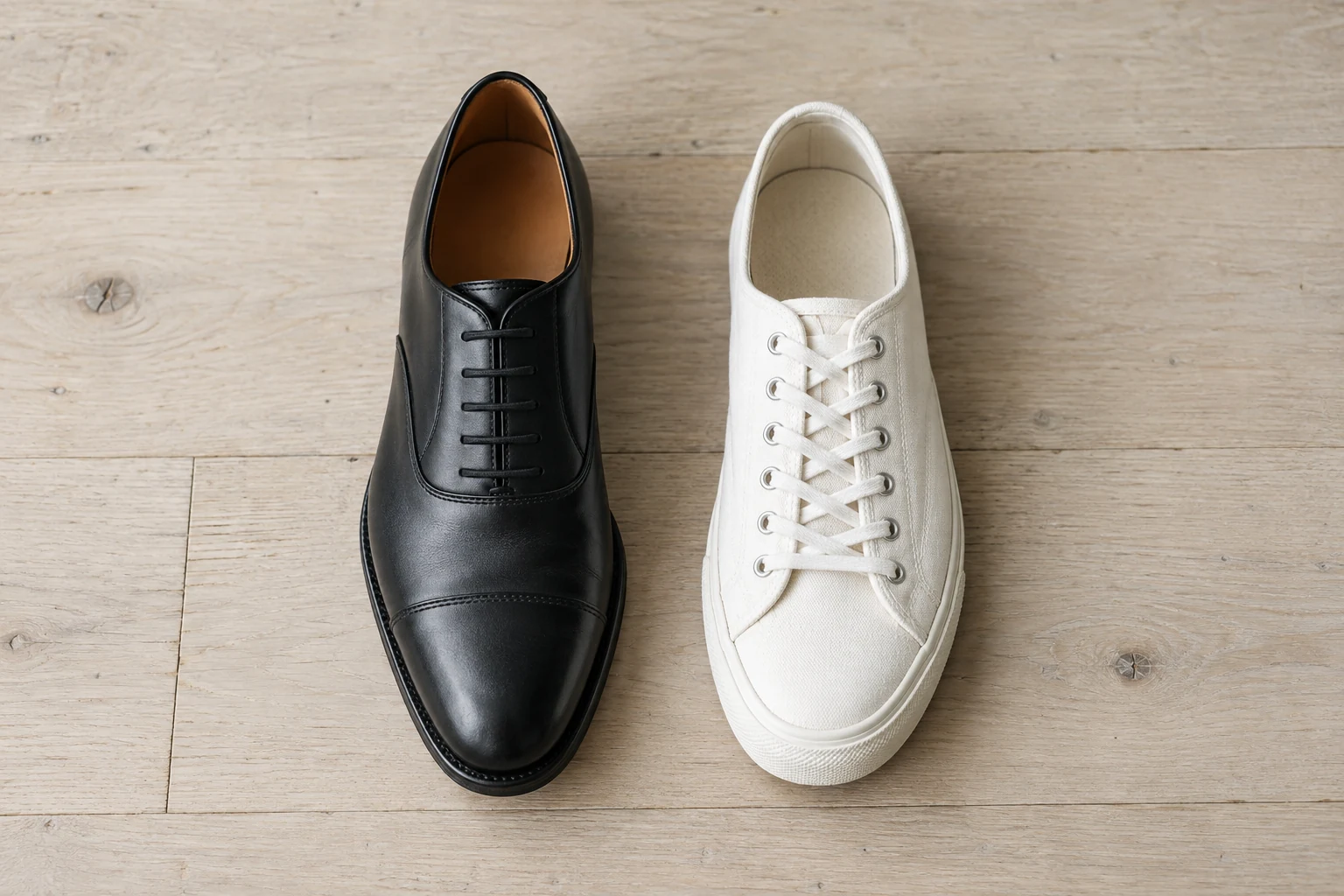
Shoes and jewelry
How to lace shoes: straight bar, criss cross and more
How to lace shoes for the job: criss cross for sneakers, straight bar lacing for dress shoes, a heel lock against slipping, and a bow knot that stays tied.
Dress codes
Black tie attire: what to wear, for men and women
Black tie attire explained: the tuxedo in detail, the shirt, bow tie and shoes, plus gowns and elegant alternatives for women and black tie weddings.
Dress codes
Business casual for men: what to wear to work
What business casual means for men at work, with outfit formulas, the right shoes, when jeans are allowed and how to read your own office's version of the code.