White tie attire: the dress code for men and women
In this guide
Most people will receive a white tie invitation once or twice in a lifetime, if at all: a state dinner, a charity ball, a university ball, a wedding in a family that keeps old traditions. The card may simply say white tie, or it may add that decorations will be worn. Either way it is asking for something more specific than your best suit or even a tuxedo. White tie attire has a fixed set of pieces, and once you know them the evening is far less intimidating.
This guide explains what white tie means and where it is still worn, every part of the men's outfit and why it looks the way it does, what women wear, and how to handle the practical side: finding a tailcoat, dressing for a white tie wedding, and what to do when you are not sure. Where something is a firm rule of the code and where it is one tradition among several, it says so.
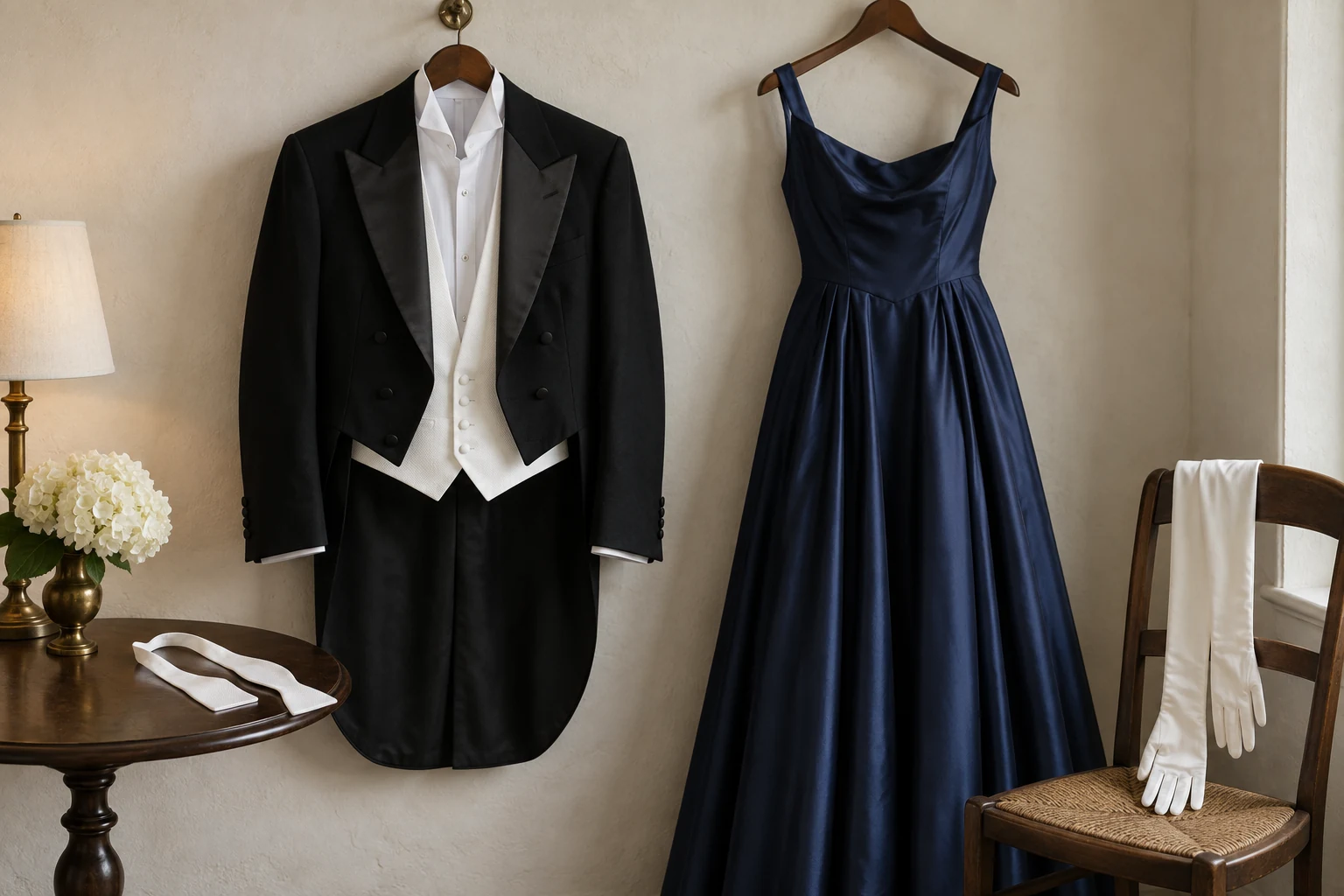
What white tie means and where it is worn
White tie is the top of the ladder of Western dress codes. The Emily Post Institute calls it the most formal of all dress codes, and it sits one step above black tie, which emerged in the 1880s as a less formal and more comfortable alternative to it. Like black tie, it is evening dress, traditionally worn at events that start after 6 pm. The name comes from the white bow tie worn by men, just as black tie is named for the black one.
Today white tie survives mainly at ceremonial and very formal occasions: some state dinners and royal events, the Nobel Prize banquet in Stockholm, the Vienna Opera Ball, May balls at Oxford and Cambridge, and a few long running dinners such as the Gridiron Club Dinner in Washington and the Al Smith Memorial Dinner in New York. It also appears at debutante balls, some formal galas and the occasional very formal evening wedding. If you have been invited to one of these, the code is meant literally, and the host expects the full set of pieces.
White tie vs black tie
The easiest way to understand white tie is to compare it with black tie. At black tie, men wear a tuxedo: a jacket with satin or grosgrain lapels, a soft pleated or piqué shirt with a turndown collar, a black bow tie, and either a cummerbund or a black waistcoat. At white tie, the tuxedo jacket is replaced by a tailcoat, the shirt gains a stiff front and a wing collar, the waistcoat and bow tie turn white, and the cummerbund disappears. In practice only the patent shoes and black socks carry over from a tuxedo.
For women the difference is length and degree. Black tie allows a floor length gown but also a dressy cocktail dress or refined evening separates. White tie narrows the choice to floor length evening or ball gowns, and long gloves become part of the traditional look rather than an eccentric extra. A white tie tuxedo does not exist in the strict sense; if you see the phrase in a rental catalog, it usually means a tailcoat set, so check that the waistcoat and bow tie are white piqué rather than black.
| Piece | Black tie | White tie |
|---|---|---|
| Jacket | Tuxedo with satin or grosgrain lapels | Black tailcoat worn open, silk faced peak lapels |
| Shirt | Soft pleated or piqué front, turndown collar | Stiff bib front, wing collar, single cuffs |
| Waist | Cummerbund or black waistcoat | Low cut white piqué waistcoat |
| Tie | Black bow tie | White piqué bow tie |
| Trousers | One silk stripe | Two narrow braid stripes, worn with braces |
| Women | Gown, dressy cocktail dress or evening separates | Floor length evening or ball gown |
Only the black patent shoes and black socks carry over from a tuxedo.
White tie attire for men, piece by piece
The tailcoat is black wool, often barathea, with peak lapels faced in silk. Its front is cut away square at the waist, and two tails fall at the back to about the back of the knee. Although it has two rows of buttons, it is not meant to be fastened; the evening tailcoat has been worn open since the nineteenth century, and the buttons are decorative. The trousers are cut from the same cloth, sit high on the waist, and carry two narrow stripes of braid down each outer seam, one more than tuxedo trousers. They have no belt loops and are held up by braces, known as suspenders in the United States.
The shirt is white with a stiff, starched or piqué bib front, a detachable or attached wing collar, and single cuffs closed with cufflinks rather than folded French cuffs. It fastens with studs. Over it goes a low cut white waistcoat, usually in cotton piqué, and it should be short enough that it does not show below the front of the tailcoat; a waistcoat peeking out beneath the coat is a common fit mistake and an easy one to spot. The white bow tie is also piqué, and it is traditionally self tied. Our guide to tying a bow tie works for a white tie too, though stiff piqué takes a little more patience than silk.
Shoes are black patent leather, either oxfords or, most traditionally, patent evening pumps with a flat grosgrain bow. Socks are black silk and long enough that no skin shows. A white linen or silk pocket square, white kid gloves carried or worn on arrival, and a black overcoat or evening cape complete the traditional set, though gloves are now optional at most events. If the invitation says decorations, guests entitled to orders or medals may wear them, usually as miniatures on the lapel.
Renting or buying white tie
Far fewer shops rent tailcoats than tuxedos, so start early, ideally a month or more before the event. Specialist formalwear rental houses in large cities and some theatrical costume suppliers carry white tie sets. Ask specifically for a tailcoat with a white piqué waistcoat, a wing collar shirt and a white piqué bow tie, and try the whole set on together, because fit problems at white tie usually come from how the pieces interact rather than from any one of them.
Check three things at the fitting. The front of the coat should end just at or slightly below the natural waist, and the waistcoat should not extend past it. The trousers should be high enough to cover the shirt at the waist when you move, which is why braces rather than a belt are essential. And the shirt collar should sit snugly with the bow tie so that the wings do not gape. If you attend white tie events regularly, buy the shirt, waistcoat and tie yourself even if you rent the coat, because they touch the body most and have the largest effect on how the outfit sits. For general tailoring principles, our guide to how a suit should fit applies to the sleeves and shoulders of a tailcoat as well.
White tie attire for women
Women wear a floor length evening or ball gown. Length is the one fixed point; within it you have freedom of color, fabric and silhouette. Full skirted ball gowns suit the most traditional balls where there is dancing, while a slim column or bias cut gown in silk, satin, taffeta, velvet or heavy crepe works just as well at a formal dinner. Color is open, and the white in white tie refers to the men's bow tie, not to your dress. Avoid white and ivory at a white tie wedding, as you would at any wedding, unless the couple asks for it.
Long evening gloves, often in white or a color matching the gown, are part of the traditional look, and Emily Post lists them as optional. If you wear them, keep them on for arriving, greeting and dancing, and take them off to eat and drink. Jewelry can be more formal than at any other event, and in British and some European court traditions tiaras appear, though that custom is specific to certain families and ceremonies and is not expected of guests in North America. Carry a small evening bag, and bring an evening coat or wrap rather than a daytime jacket. Formal trousers are rarely seen at white tie, and at a traditional ball or state event a gown is still expected, so if you prefer trousers, ask the host first.
White tie wedding attire
A white tie wedding is rare, and when a couple chooses it they usually mean it. Male guests are expected in tailcoats, and the wedding party will often wear them too, sometimes with small variations such as a different waistcoat for the groom. Female guests wear floor length gowns, and the usual wedding customs apply: avoid white and anything that could read as bridal, and check whether the ceremony venue expects covered shoulders, which a gown with sleeves or a wrap easily solves.
White tie weddings are almost always in the evening. A formal daytime wedding that asks for tailcoats is really asking for morning dress, which uses a gray or black morning coat with striped trousers, and it is a different code. If you have any doubt about what the couple wants, ask them or the wedding party directly. Our broader guide to wedding guest attire covers the other dress codes you might see on an invitation.
Common mistakes
Wearing a tuxedo to a white tie event
A tuxedo is black tie, one step below. If you cannot get a tailcoat, tell the host before the event rather than surprising them; some will welcome you in black tie, others would rather know.
Letting the waistcoat show below the coat
The white waistcoat should end above the front edge of the tailcoat. A long waistcoat, often from a rental set, breaks the line and is the detail people notice first.
Wearing a black waistcoat or black bow tie
At white tie, both are white. Black versions belong to black tie, and mixing them with a tailcoat produces an outfit that matches neither code. Check rental sets carefully, since they sometimes include the wrong color.
Questions people ask
Which is fancier, black tie or white tie?
White tie is more formal. It is the highest evening dress code, and black tie was originally the less formal alternative to it. If an invitation says white tie, a tuxedo is not enough.
What is the female equivalent of white tie?
A floor length evening or ball gown, usually with long gloves and formal jewelry. Unlike black tie, shorter cocktail dresses and dressy separates do not meet the code.
Does anyone still wear white tie?
Yes, though rarely. It is still expected at some state dinners and royal occasions, the Nobel Prize banquet, the Vienna Opera Ball, Oxford and Cambridge May balls and a handful of formal dinners and debutante balls. Most people who go to formal events will meet black tie far more often.
Does black tie mean you have to wear a white shirt?
Yes, traditionally. Black tie means a white dress shirt with a pleated or piqué front, worn with a black bow tie. The black in the name refers to the tie, not the shirt, and white tie also uses a white shirt, only with a stiff front and wing collar.
Sources and further reading
References used for this guide. Each opens the original page in a new tab.
Keep reading
Dress codes
Black tie attire: what to wear, for men and women
Black tie attire explained: the tuxedo in detail, the shirt, bow tie and shoes, plus gowns and elegant alternatives for women and black tie weddings.
Suits and tailoring
Suit vs tuxedo: how to tell them apart and which to wear
Suit vs tuxedo explained: the satin lapels, trouser stripe and bow tie that set a tuxedo apart, and which one a wedding, prom or black tie invitation asks for.
Ties and knots
How to tie a bow tie, step by step
Learn how to tie a bow tie step by step, with a checkpoint after each fold, how to find the hidden opening, and how to fix a bow that is lopsided or loose.
Dress codes
What to wear to a gala
Most galas are black tie or black tie optional. How to read the invitation, what women and men wear, whether a suit or trousers work, and what to avoid.
Ties and knots
How to wear cufflinks with a French cuff shirt
How to wear cufflinks: which shirts take them, how to fold and fasten a French cuff, kissing vs barrel style, cufflink types, and when to wear them with studs.