Korean fashion: the looks, pieces and outfits to know
In this guide
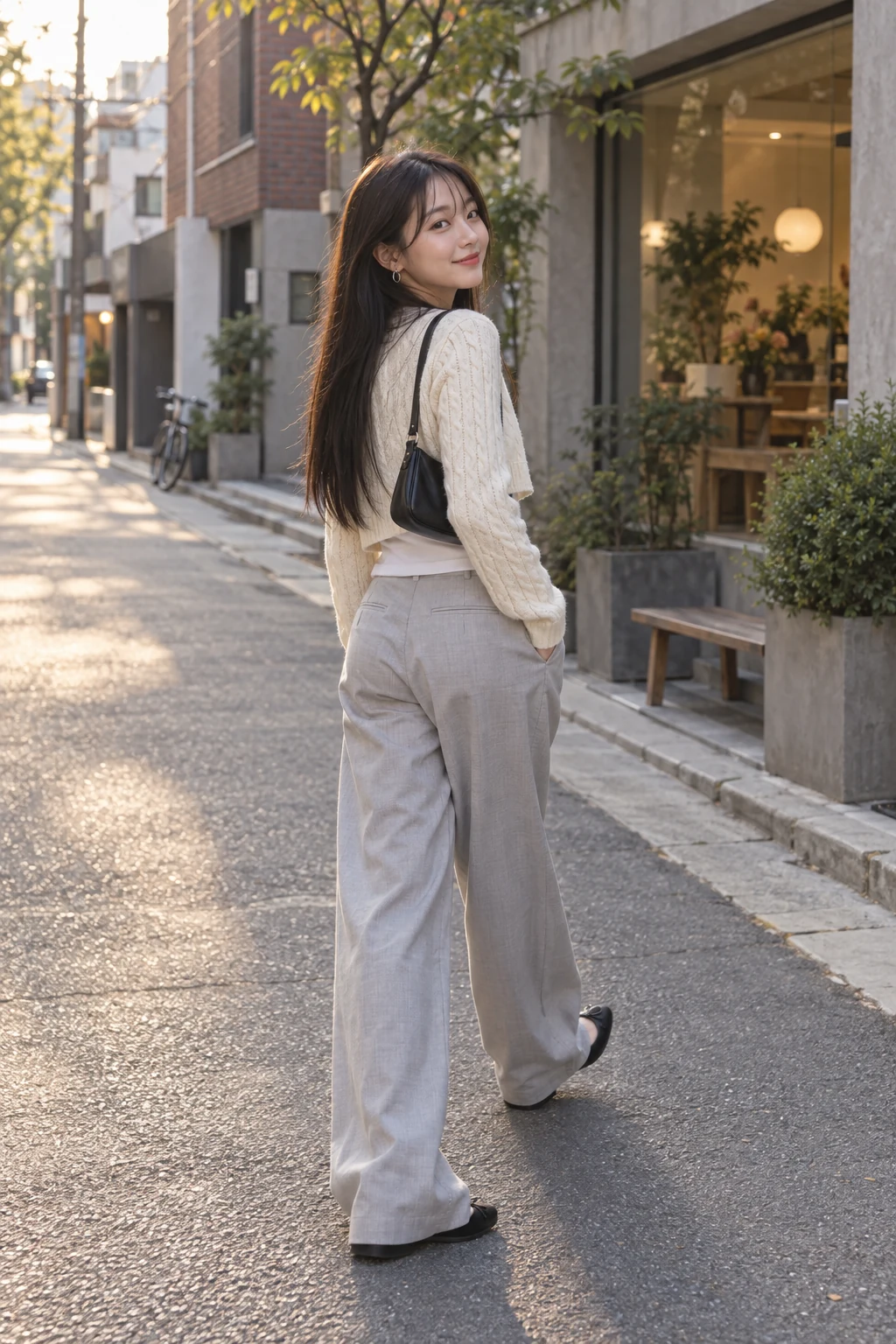
You have saved dozens of outfit photos from Seoul: a cream knit tucked loosely into gray wide trousers, a long coat over a hoodie, a pleated skirt with chunky loafers. They look calm and expensive, yet when you try to copy one, it comes out either plain or a little like a costume. Korean fashion works less through specific pieces than through proportion, color and finish, and those are things you can learn.
This guide explains what Korean fashion means right now, where it comes from, how traditional hanbok fits in, the pieces and colors that carry the look, and complete outfits for class, work, weekends and dates. There is a short section for men and a longer one on hair and finishing touches, because in Seoul the outfit is only half of the picture.
What Korean fashion is today
Modern Korean style fashion grew quickly after the Korean War. Mass production of clothing began around 1960, a women's ready to wear industry followed in the 1970s, and Seoul Fashion Week started in 1987 and still runs twice a year. From the 2000s the Korean Wave, the global reach of K dramas and K pop, turned Seoul into one of the places the rest of the world watches for ideas. Harper's Bazaar once summed up Korean style as a mix of streetwear and luxury, and that tension is still at the heart of it.
What most people mean by Korean fashion now is the everyday look of young people in neighborhoods like Seongsu, Hongdae and Hannam: relaxed but tidy clothes, muted colors, soft fabrics and careful layering. It is not one uniform. Some people dress in quiet minimal knits, some in oversized streetwear, some in sweet, feminine pieces with bows and pleats. What they share is a sense that the clothes should look considered and cared for, never sloppy, even when they are loose.
Traditional Korean fashion: the hanbok
Traditional Korean fashion means the hanbok. The basic set is a short jacket called a jeogori, worn by everyone, with a full, high waisted skirt called a chima for women or loose trousers called baji for men, and a long outer robe called a po or durumagi on top. Today most Koreans wear hanbok on holidays such as Seollal, the Lunar New Year, and Chuseok, the autumn harvest festival, and at weddings and family ceremonies, not as daily clothing.
Hanbok is also part of daily life in a newer way. Since 2013 the royal palaces and Jongmyo Shrine in Seoul have offered free admission to visitors wearing hanbok, and renting one for a palace visit and a photo walk has become popular with locals and tourists alike. The palace rules ask for a real two piece outfit, a jeogori with a skirt or trousers, rather than a hanbok style dress, and since 2019 anyone may wear either the skirt or the trouser version. If you rent one, treat it as what it is, a cultural garment, and follow the rental shop's guidance on how to tie the ribbon on the jeogori. Some modern designers borrow the wrapped collar, the high skirt line or the soft colors of hanbok for everyday clothes, which is a respectful way to wear the influence without dressing up.
The key pieces, colors and proportions
Most Korean outfits are built from a short list. On top: fine gauge knits, cardigans, crisp oversized shirts, plain heavyweight T shirts, sweatshirts and knit vests. On the bottom: wide or straight trousers with a soft crease, straight or wide jeans, long pleated or A line skirts and, for a sweeter look, short pleated skirts. Outer layers matter a lot: a long wool coat, a short boxy jacket, a trench, a padded vest in winter. Shoes are simple and a little chunky, such as white sneakers, loafers, Mary Janes and ballet flats, and the bag is small or a soft canvas tote.
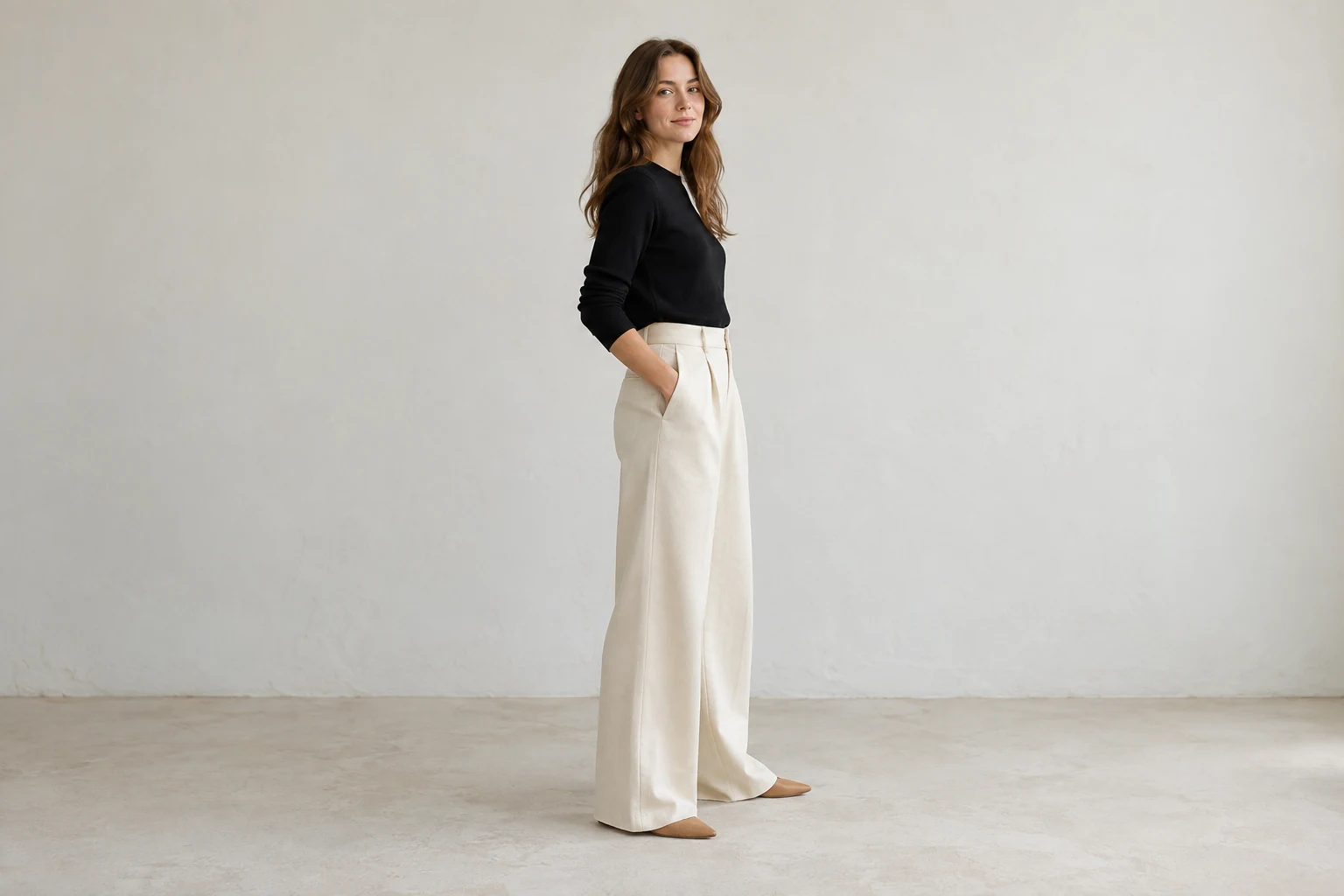
Colors stay calm: cream, oatmeal, gray, charcoal, navy, black, soft brown and washed denim, with one muted accent such as dusty pink, sage or powder blue. Our guide to colors that go together explains why tonal outfits in one family look so polished. Proportion is the real secret. Korean outfits often pair a loose top with a long, wide bottom and let the whole figure read as one soft column, or pair a short top with a long skirt to set the waist high. Fit still matters inside that looseness: shoulders that sit right, trousers that clear the floor or break once over the shoe, and knits that are soft rather than stretched.
Korean fashion trends and looks to know
Soft minimal is the look most people picture. It is a cream or gray knit, charcoal wide trousers or straight jeans, loafers or clean sneakers, a long coat in camel or charcoal and very little jewelry. It overlaps with minimalist style but is softer, with more texture and more volume in the trousers. Acubi, a look that grew out of Seoul street style and online communities, takes the same muted palette and makes it moodier and more layered, with baggy jeans, zip hoodies, shrunken cardigans, thin tank tops layered under sheer tops and small silver jewelry.
Campus preppy uses knit vests over shirts, pleated skirts or chinos, cardigans, loafers with white socks and a canvas tote, close to preppy style but looser and quieter. Street style, strongest around Hongdae, borrows from streetwear with wide cargo pants, boxy jackets, caps and chunky sneakers, and often mixes one sporty piece with one tailored one. Feminine romantic brings ribbons in the hair, ruffled blouses, long floaty skirts, ballet flats and soft pastels. Korean fashion trends turn over quickly, so rather than chasing each one, pick the look that feels like you and let trends touch it one piece at a time.
| Look | Key pieces | Colors |
|---|---|---|
| Soft minimal | Fine knit, wide trousers, long coat, loafers or clean sneakers | Cream, gray, charcoal, camel |
| Acubi | Baggy jeans, zip hoodie, shrunken cardigan, layered tanks, silver jewelry | Gray, black, washed blue, muted khaki |
| Campus preppy | Knit vest over a shirt, pleated skirt or chinos, loafers, tote | Navy, cream, brown, soft green |
| Street | Cargo pants, boxy jacket, cap, chunky sneakers | Black, olive, gray, one bright accent |
| Feminine romantic | Ruffled blouse, long floaty skirt, ballet flats, hair ribbon | Ivory, pastel pink, powder blue |
Pick one look per outfit and borrow at most one piece from another.
Korean outfits for women, by situation
For class or a long day in the city, wear a cream crew neck knit tucked in at the front only, gray wide trousers that break once over white sneakers, a navy canvas tote and a claw clip holding half your hair. If it is cool, around 50°F (10°C), add a long charcoal coat left open so the knit and trousers read as one line. For work in a casual office, swap the sneakers for black loafers and the knit for a crisp white oversized shirt with the sleeves pushed up once, worn with charcoal straight trousers and a thin belt.
For a weekend café date, try a soft pink cardigan buttoned as a top, a long ivory pleated skirt, white socks and black Mary Janes, with a small shoulder bag and a ribbon or small pearl earrings. For a Seongsu style afternoon of shops and photos, wear light blue wide jeans, a fitted gray long sleeve T shirt under a cropped zip hoodie and chunky sneakers, with a baseball cap and tiny silver hoops. For a night out, a black slip skirt with a fine black knit, a short boxy leather jacket and pointed flats keeps the palette calm but the textures rich. Each of these is built from basics, so the same pieces combine into many more outfits than they seem to at first.
Korean fashion for men, in brief
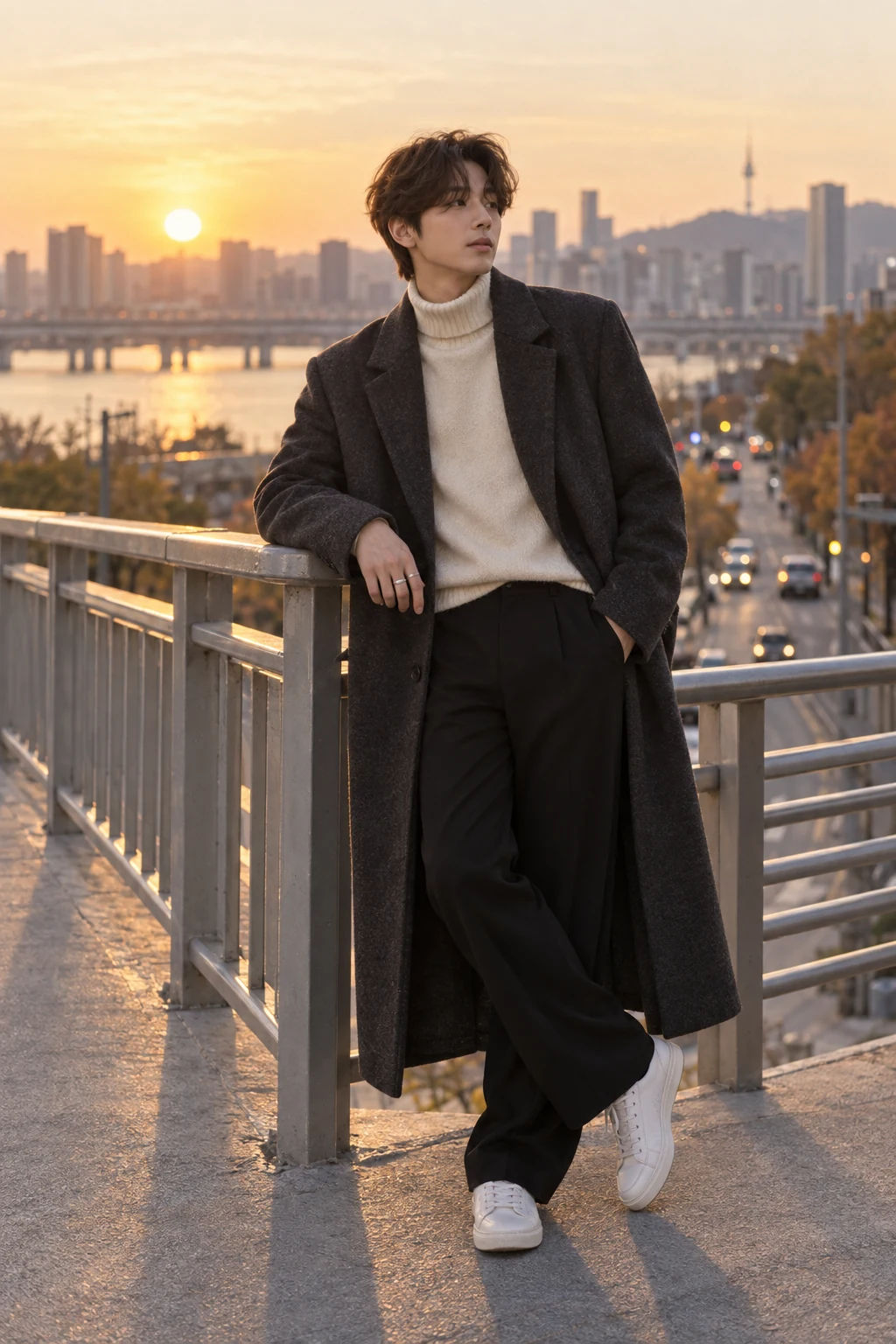
Korean men's fashion follows the same logic: relaxed but neat, calm colors, careful layers. A typical outfit is a heavyweight white T shirt under an open oversized shirt, charcoal wide trousers and white leather sneakers, or a gray hoodie under a long navy coat with straight dark jeans and loafers. In warmer months, a short sleeve knit polo, pleated beige trousers and clean sneakers look sharp without trying. Hair and skin care are taken seriously, which is a big part of why simple clothes look finished.
If you are building this for yourself or shopping with a partner, our full guide to Korean fashion for men goes deeper into fits, hair and seasonal outfits. The one rule that transfers everywhere is to size for a relaxed silhouette on purpose, with shoulders that fall only slightly and trousers that are wide but the right length, rather than simply buying everything too big.
Korean hair fashion and the finishing touches
In Korean style, hair is part of the outfit. For women, long straight hair with a soft inward bend at the ends, a hime cut with cheek length side pieces, a short bob with a gentle curve and see through bangs are all common, and a claw clip, a ribbon or a plain headband finishes the look. For men, soft perms, curtain bangs that part in the middle and textured short cuts are the familiar shapes. The common thread is hair that looks soft and cared for rather than stiff with product.
Small things finish the rest. Socks are chosen, often white or a soft gray showing between trouser and shoe. Jewelry is thin and quiet: silver hoops, a slim ring or two, a fine chain. Bags are small, soft and simple, sometimes with a keyring charm. Clothes are pressed or steamed, knits are kept free of pilling and sneakers are clean, and our guide to steaming clothes helps with the crisp shirts and soft trousers this style relies on.
How to wear it without looking like a costume
A Korean look goes wrong when it is copied piece by piece from one photo without the proportions or the finish that made it work. Start instead with what you own. Pull out your softest knit, your widest or straightest trousers and your cleanest simple shoes, and try them together in one color family. Then check the three things that matter most: that the top and bottom volumes are balanced, that the trousers are the right length, and that everything looks fresh.
If something is missing, it is usually one pair of wide trousers in gray or charcoal, one cream knit and one long coat. Add those first and most of the outfits above become possible. Korean fashion is also more respectful of the culture when it is worn as ordinary clothing rather than as a theme. You do not need to change your hair, your makeup or your face to wear it well; you only need the calm colors, the soft shapes and the care.
Common mistakes
Sizing everything up
Relaxed is a proportion, not a size. When the shoulders, sleeves and trousers are all too big, the outfit looks borrowed. Keep one element loose and make sure the length of sleeves and trousers is right.
Too many colors at once
Much of the calm in Korean outfits comes from a narrow palette. If you are wearing three strong colors, swap two for cream, gray or navy and keep one soft accent.
Neglecting condition
Soft knits and pale sneakers show wear quickly. Pilling, creases and scuffs undo the polished look faster than any wrong piece, so steam, depill and clean regularly.
Questions people ask
What style is Korean fashion?
Korean fashion is a broad term, but the everyday look is relaxed, layered and tidy, with muted colors, soft fabrics and deliberate proportions. Inside that there are several distinct looks, including soft minimal, Acubi, campus preppy, street style and feminine romantic.
How do I find good Korean fashion brands?
We do not recommend specific brands, but you can judge any label by what matters in this style: natural or soft fabrics, trousers cut wide but in true lengths, and knits that recover after washing. Many shoppers look at Korean online boutiques and independent Seoul labels; check the size charts in centimeters carefully, because Korean sizes are labeled differently from North American ones and many pieces come in one size.
Can I wear a hanbok if I am not Korean?
Yes. Visitors in Korea are welcome to rent and wear hanbok, and the palaces in Seoul even offer free admission to people wearing a proper two piece hanbok. Wear it respectfully, as a cultural garment rather than a costume, and follow the rental shop's guidance on fit and tying.
What are the current Korean fashion trends?
Recent years have leaned toward wide trousers and wide jeans, soft tonal knits, long coats, Mary Janes and ballet flats, hair ribbons and quiet silver jewelry, with the moodier Acubi look popular online. Trends change fast, so add them one piece at a time to a base of calm basics.
Sources and further reading
References used for this guide. Each opens the original page in a new tab.
Keep reading
Styles
Korean fashion for men: pieces, proportions and outfits
Korean fashion for men explained: the soft tailored pieces, calm colors and relaxed proportions behind the Seoul look, with outfits for class, work, dates, winter.
Styles
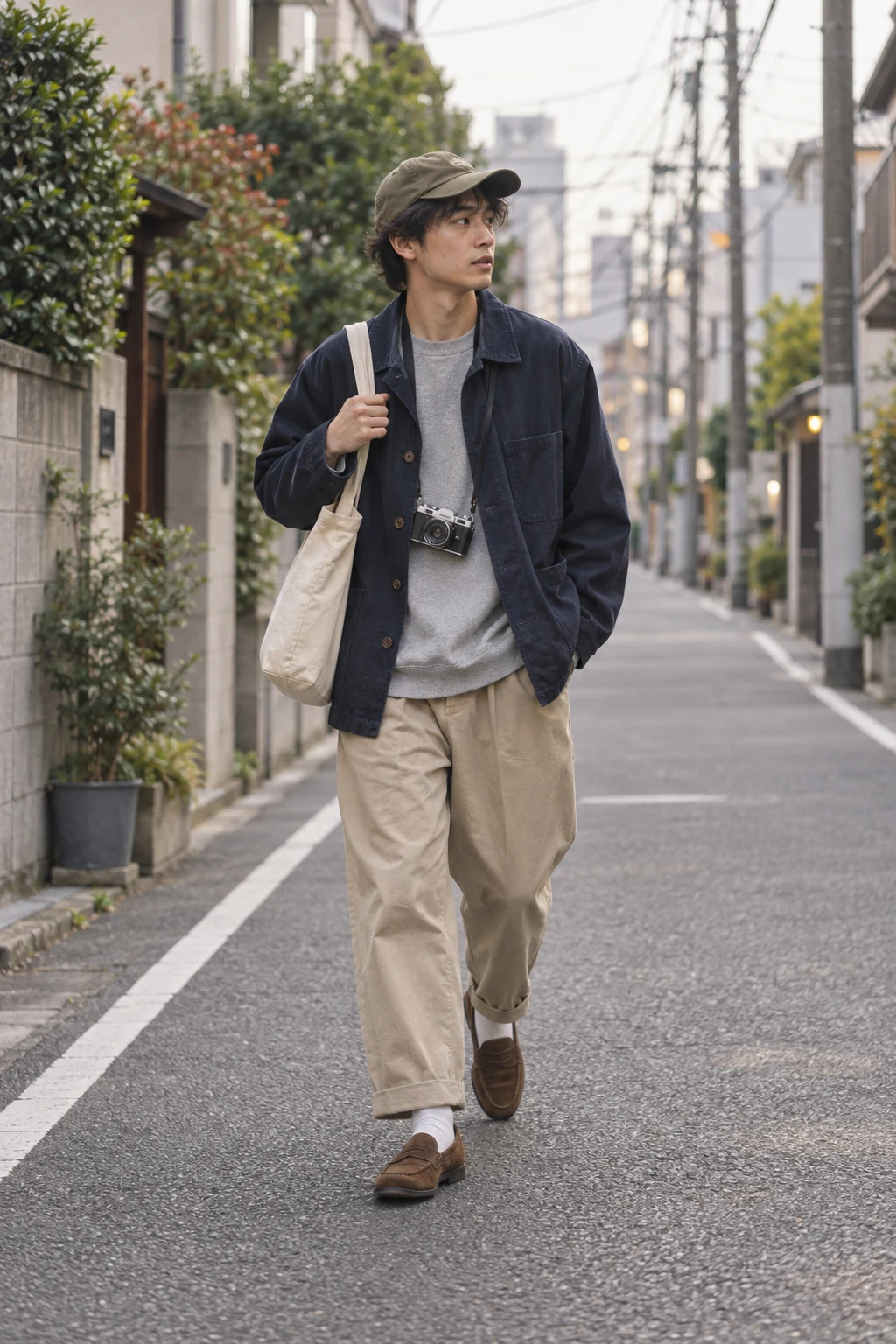
Japanese street style: the looks, pieces and outfits
Japanese street style explained: where it came from, the main Tokyo looks from city boy to Harajuku, the key pieces, and outfits for men and women to try.
Styles
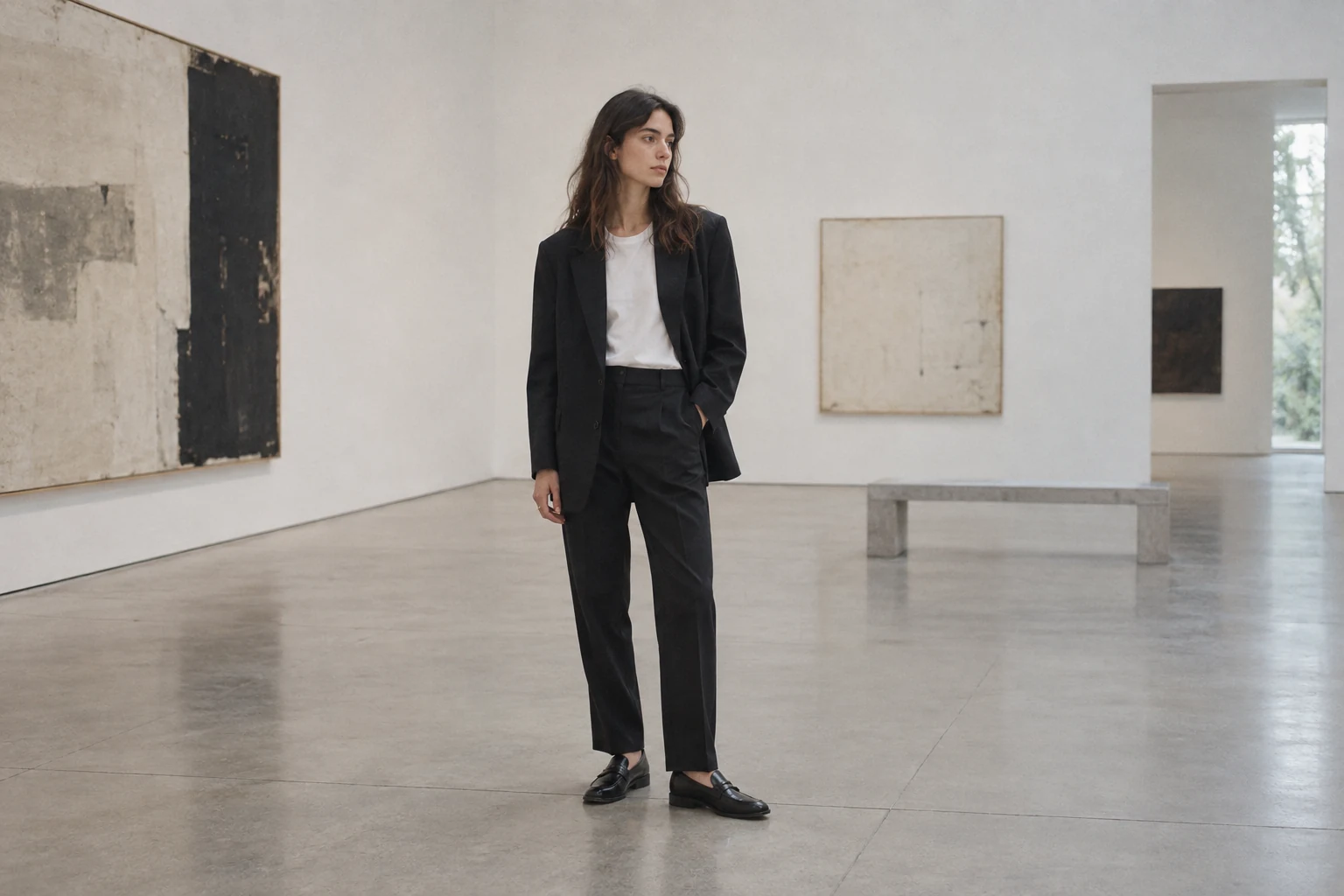
Minimalist style: fewer pieces, better outfits
What minimalist style really is, where it came from, the pieces, colors and fabrics it relies on, and minimalist outfits for men and women that never look plain.
Everyday style
K pop outfits: what to wear to a concert and beyond
K pop outfits for concerts, parties and dance class: how idol style works, what to wear for a long standing show, fandom colors, and KPop Demon Hunters looks.
Everyday style
How to style wide leg pants: tops, shoes and hems
How to style wide leg pants with the right tops, shoes and hem length, for work and weekends, with practical fixes for pants that drag, swamp you or feel sloppy.