How to distress jeans at home
In this guide
A pair of jeans takes years of real wear to fade at the thighs, whisker at the hips and give way at the knee. If a pair is too new, too dark or simply too plain, you can speed that history up in an afternoon. Learning how to distress jeans at home is mostly about restraint: a little abrasion in the places a body really wears denim looks natural, while too much in the wrong places looks like an accident.
This guide covers three levels of wear, from a gentle weathered fade that leaves no holes, to the white thread knee rip, to a frayed raw hem. Each works best on a particular kind of denim, and each keeps changing in the wash, so the last part explains how to finish the job and keep it from going further than you meant.
What distressed denim is, and how factories make it
Distressed denim imitates the wear of use: lighter patches where the surface has been rubbed, soft fuzz along edges, and patches where the blue threads have broken to show the white ones underneath. Levi's makes a useful distinction between that and ripped jeans, which have open holes. Denim is a twill woven with indigo dyed threads running lengthwise and undyed white threads running across, and indigo sits mostly on the outside of each yarn. Abrasion removes the dyed surface and exposes paler fiber, which is why rubbing fades denim and why a worn knee turns white before it opens.
Commercial finishing uses the same logic at scale. Garments are tumbled with pumice stones, sanded by hand, brushed, lasered or treated with chemicals. Sandblasting, once common, has been abandoned by many brands because the silica dust caused silicosis, an incurable and often fatal lung disease, among the workers who did it; the Clean Clothes Campaign has documented that it persisted in some factories after those bans. At home, the gentler hand methods below reproduce the look without that dust, and sanding a single pair outdoors or by an open window is a very different exposure from a factory floor.
Tools, and which jeans take distressing well
The tools are simple: tailor's chalk or a bar of soap for marking, a piece of cardboard or a thin cutting board to slide inside the leg, medium to coarse sandpaper or a pumice stone, a craft knife or small sharp scissors, tweezers, and a seam ripper for hems. A stiff brush or a cheese grater can stand in for sandpaper. You will also want a well lit table and patience, because the best results build up slowly.
Rigid, 100% cotton denim distresses most convincingly. The white weft threads survive while the blue ones break, so you get the classic ladder of white threads across a knee. Stretch denim contains elastane, and when those threads are cut they tend to snap back and curl, so rips spread faster and the edges look less tidy. If your jeans are stretch, favor sanded fades over open rips. Thrifted or older jeans are ideal practice, since the fabric is already softened and a mistake costs little. Check the fit first; our guide to how jeans should fit is worth a look before you commit to a pair.
Plan where the wear goes
Put the jeans on and mark the spots with chalk while standing in front of a mirror. Real wear appears where the body presses and bends: across the front of the thighs, just above the kneecap, along the edges of the front pockets, on the back pockets where a wallet or phone sits, and at the hem where it scuffs the ground. Marking while wearing matters, because a knee rip placed on flat jeans usually ends up too low once you stand. Sit down too and check that nothing will land on a seam you did not intend.
Keep it asymmetrical. One knee a bit more worn than the other, one pocket edge frayed and not the other, reads as real life. Two identical holes at the same height look manufactured. Start with less than you think you want; you can always add another pass, and removing a hole is impossible.
How to distress jeans without holes: sanded fades
This is the most forgiving method and the one to use for a weathered, lived in look. It is also how to distress jeans without washing them first if you want an instant result, although a wash afterward makes it look softer and more real.
Slide a board inside the leg
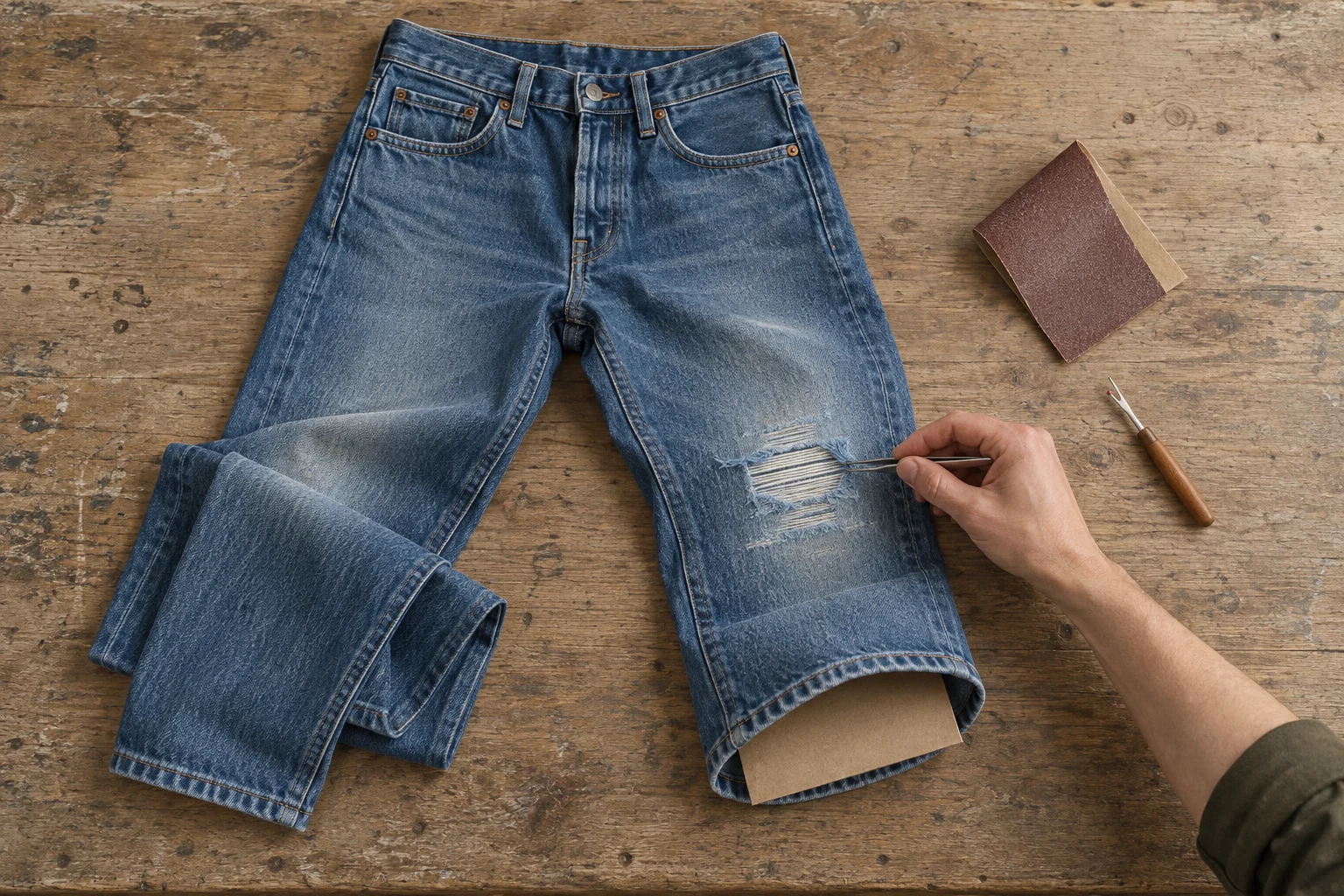
Push cardboard or a thin cutting board into the leg under the marked area. Levi's recommends this so you only wear through the front layer. The fabric should lie flat and tight over the board.
Rub with sandpaper or pumice
Rub back and forth over one small area at a time, with light to moderate pressure. Brush away the blue lint as you go so you can see the change.
CheckYou should see the surface lighten and turn slightly fuzzy after a minute or two.
Blend the edges
Real fading has no hard outline. Lighten your pressure toward the edge of each patch so it fades out gradually into the darker denim around it.
Stop before the threads break
Hold the fabric up to the light. When you can see a slight thinning, stop; the wash will add a little more wear. Pressing on past this point is how to start a hole deliberately.
How to make the white thread knee rip
Levi's tailors make this look with chalk, scissors and tweezers. Draw three or four short horizontal lines across the marked area, a small distance apart, keeping them parallel to the hem. Slide the board in, then cut along each line through the front layer only, either with a craft knife or by pinching a fold and snipping. Keep each cut an inch or two (3 to 5 cm) long to start; they will look wider once the threads loosen.
Now use tweezers to pull out the blue threads between the cuts. They run vertically, so pick at the cut edge and draw them downward one at a time. Leave every white horizontal thread in place. You are after a patch of white ladder where the blue has gone. If a white thread breaks, that is fine; if several do, the patch becomes an open hole, which is a different style. On stretch denim, cut fewer and shorter lines, since the patch will grow on its own.
How to distress a jeans hem
A frayed hem is the subtlest distressing and works on almost any pair. To keep the length, use a seam ripper to open the stitched hem and pull out the thread, then press the fold flat and rub the new edge with sandpaper so it starts to fray. To shorten at the same time, cut straight across at the length you want, remembering that the edge will fray back about half an inch (1 cm) in the wash. A cropped, frayed hem sits well with loafers and sneakers; our guide to cuffing jeans covers the alternatives if you change your mind. Brush the raw edge with a stiff brush or pull a few horizontal threads for a fuller fringe.
| Method | Best on | Result | Watch for |
|---|---|---|---|
| Sanded fade | Any denim, including stretch | Weathered, lighter patches without holes | Stop when you see slight thinning |
| White thread rip | Rigid 100% cotton denim | Ladder of white threads across the knee | Stretch denim rips spread and curl |
| Frayed hem | Almost any pair | Subtle raw edge | Edge frays back about half an inch in the wash |
Fading with bleach, and the finishing wash
Some people lighten a whole pair with bleach before distressing, to make it look older overall. It works, but chlorine bleach also weakens cotton, fades unevenly, and can turn the thread and the rivets yellow. If you try it, dilute it well in a bucket outdoors or in a ventilated room, wear gloves, check every few minutes and stop by rinsing thoroughly in cold water. Never mix bleach with vinegar, ammonia or other cleaners, since the combinations release toxic gases. Our guide to dyeing clothes covers the gentler route of changing a color deliberately.
Every method finishes with a wash. Turn the jeans inside out, wash cold on a gentle cycle and air dry, as Levi's advises. The wash softens cut edges, fluffs the white threads and makes sanded patches look less raw. Expect distressed areas to keep evolving; open holes grow, especially at the knee. To stop a rip from spreading, stitch a few loose zigzag lines across the back of the patch or iron a denim patch behind it. Our guide to washing jeans explains how often to wash so the fade stays yours.
Common mistakes
Marking the jeans flat on a table
Knees and thighs sit differently once you stand. Mark while wearing the jeans so the wear lands where your body would make it.
Cutting through both layers
Without a board inside the leg, a knife or sandpaper goes through the back of the leg too. Always slide something firm inside first.
Doing everything at once
Distressing looks best built up slowly. Wash after a first light pass, see how it settles, then add more if you want it.
Drying on high heat
Hot tumbling tears cut edges and makes holes grow fast. Air dry distressed jeans every time.
Questions people ask
What is the easiest way to distress jeans?
Sandpaper over a board slid inside the leg, followed by a cold wash. It needs no cutting, the risk is low, and you can stop at any point. A seam ripped, frayed hem is the next easiest step.
How do I distress jeans without sandpaper?
A pumice stone, a cheese grater, a steel wire brush or even a rough stone step will abrade denim in the same way. Work slowly with any of them, since graters and wire brushes cut faster than sandpaper. A craft knife run lightly across the surface also shaves off the blue fibers.
Can you distress stretch jeans?
You can, but keep to sanded fades and frayed hems. Cut elastane threads snap back and curl, so rips on stretch denim spread quickly and look messy. If you want a white thread knee, choose a pair that is 100% cotton.
Can you wear distressed jeans to work?
In most offices, visibly ripped jeans are too casual, even where dark jeans are allowed. A light fade or a neat frayed hem is easier to get away with in relaxed workplaces. Our guide to business casual explains where jeans usually fit.
Sources and further reading
References used for this guide. Each opens the original page in a new tab.
Keep reading
Everyday style
Types of jeans: fits and cuts explained
The main types of jeans explained: rise, skinny to baggy leg shapes, bootcut, flare, wide leg, mom and boyfriend jeans, with what each suits and how to wear it.
Washing and ironing
How to wash jeans and how often to do it
How to wash jeans so they keep their color and fit: how often to wash, inside out in cold water, air drying, raw denim and what to do if your jeans shrink.
Fabrics
What is denim? Raw, selvedge and stretch explained
What denim is made of, why it is blue, how it differs from jeans, and what raw, selvedge, sanforized and stretch denim mean when you shop for jeans or a jacket.
Everyday style
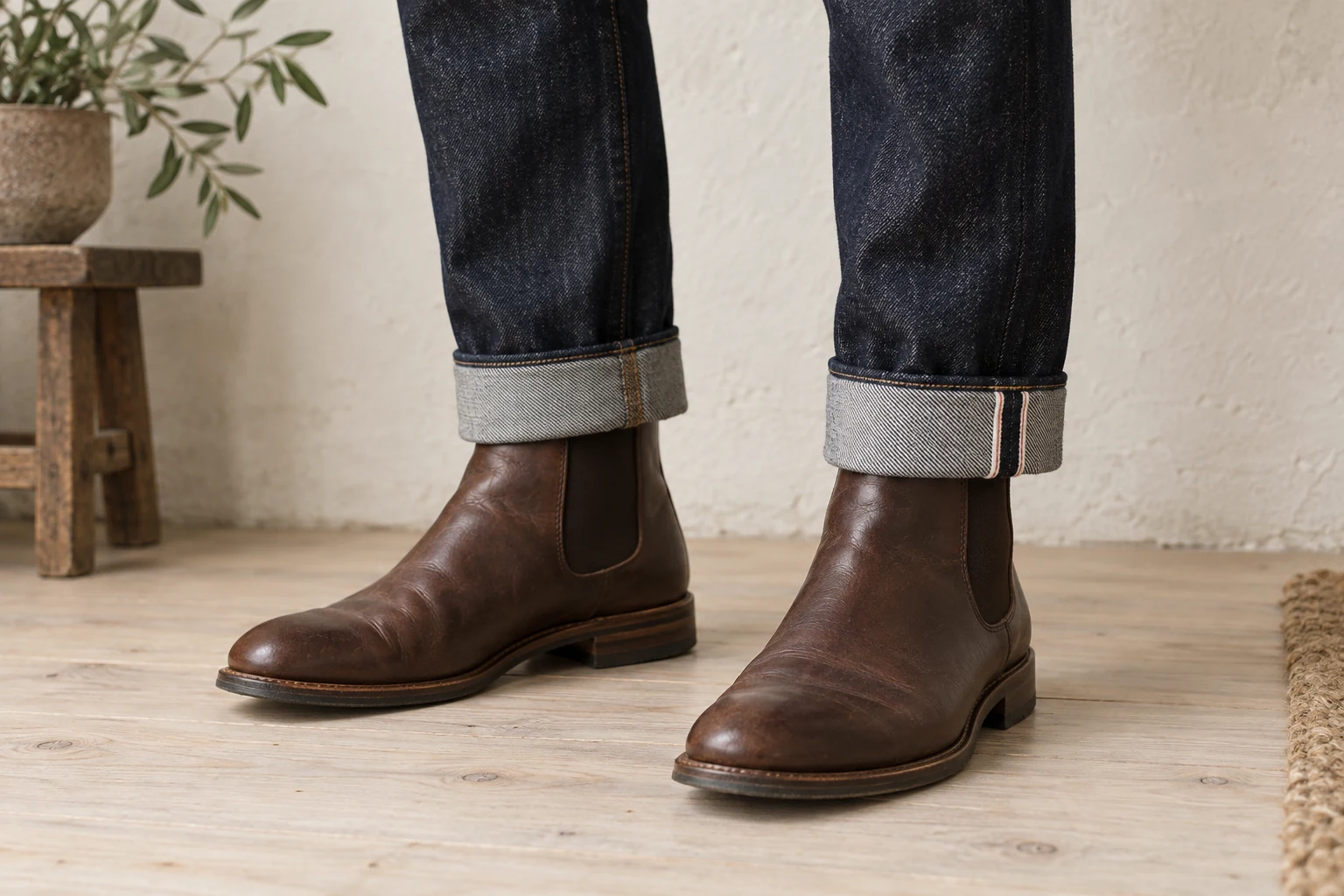
How to cuff jeans: single, double and pinroll
How to cuff jeans neatly: single, double, pinroll and Japanese cuffs, which jeans and shoes each one suits, and when to hem instead of rolling.

Sizing
How should jeans fit? Waist, seat, thigh and length
How should jeans fit at the waist, seat, thigh and ankle? Clear checks for men and women, how rigid and stretch denim change, and where the hem should land.