How to measure shoe width at home
In this guide
Shoes that fit in length can still press on the little toe, pinch across the joint behind the big toe or leave your foot sliding side to side. When that keeps happening, the problem is usually width, and a pair of shoes in the right letter can feel like a different size altogether.
Learning how to measure shoe width takes five minutes and a few household things. The number alone does not tell you your width, though, because a 4 inch foot is standard in one length and wide in another. This guide covers the measurement, how to read the letters for men and women, and how to use the result when you buy.
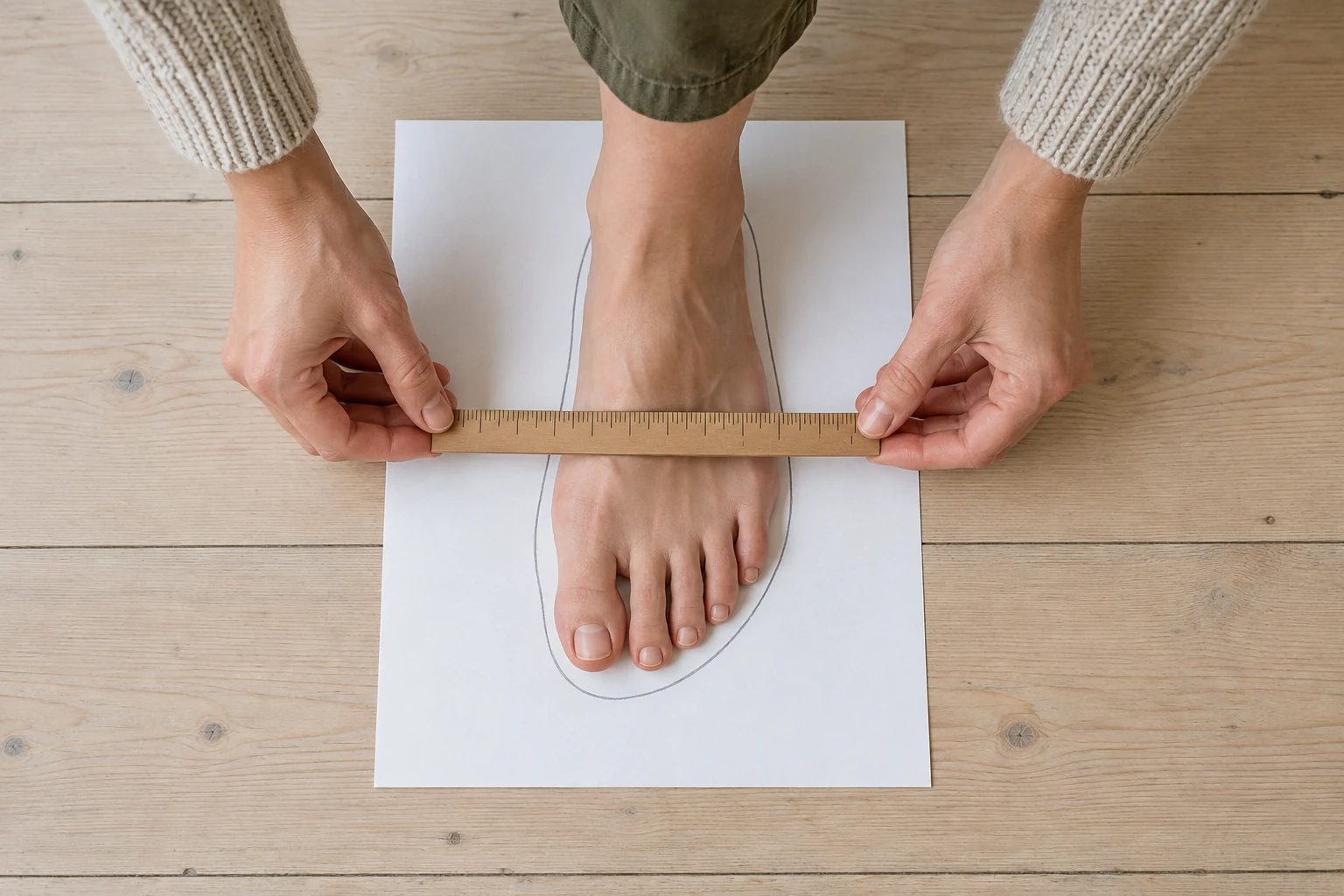
How to measure shoe width at home
You need a sheet of paper larger than your foot, a pencil, a ruler or tape measure, and the socks you usually wear with the shoes you are buying. Measure late in the day: the American Academy of Orthopaedic Surgeons notes that feet can swell during the day, by up to about 8 percent, and a morning measurement can mislead you into a shoe that feels tight by evening. You also need to stand, because body weight spreads the foot to its full width.
Stand on the paper
Put the paper on a hard floor, against a wall if you also want your length. Stand with your weight shared evenly between both feet, as Brannock's instructions ask, so the foot spreads as it does when you walk. A seated measurement comes out narrower than your foot really is when you walk.
Trace the outline
Hold the pencil upright, straight up and down, and trace close around the foot. A slanted pencil adds width. If balancing is hard, ask someone else to trace for you while you stand still.
Find the widest part
Mark the widest point on each side of the tracing. It is almost always across the ball of the foot, the joints behind the big toe and little toe, not at the toes themselves.
Measure straight across
Measure the straight line between the two marks, to the nearest eighth of an inch or the nearest millimeter. Subtract a small allowance, about an eighth of an inch (3 mm), if your pencil line sat noticeably away from the skin.
Repeat on the other foot
Most people have one foot slightly larger than the other. The Brannock Device Company advises measuring both and fitting the larger one.
Measure with a tape measure, and why girth also matters
A flexible tape wrapped around the ball of the foot gives a different number: the girth, or circumference, not the width. Shoemakers build lasts around girth as well as width, so it is useful if a brand publishes it, but do not compare a girth with a width chart. To measure girth, stand, wrap the tape around the widest part of the foot over your usual sock, snug but not tight, and read where the tape meets itself.
Two feet can have the same width across the ball and very different volume. A high instep or a thick, fleshy foot needs more room than the flat width suggests, while a low, thin foot can swim in a wide shoe. The Brannock company puts this into its fitting advice: when a foot falls between widths, choose the wider width for a thick foot and the narrower one for a thin foot. The same thinking helps when you measure yourself for clothes: the tape records one line, and your body adds the rest.
Read the shoe width letters for men and women
North American shoes use letters for width, running from very narrow letters such as AAA through B, C and D to wide letters written as E, EE (also 2E), EEE (3E) and so on. The standard or medium width is different for men and women. For men, D is standard; the wide fitting is labeled E or, more often, 2E, and extra wide is usually 3E or 4E, with B or C as narrow. For women, B is standard, D is the usual wide fitting and 2E or more is extra wide, with 2A as narrow. Shoes marked only with a number are almost always the standard width, and an M after the size means medium.
The steps between letters are small. Wikipedia's summary of the Brannock scale gives about 3/16 of an inch (about 5 mm) between widths, while retail charts that group letters into columns often step about an eighth of an inch (3 mm) from standard to wide. Either way, one step wider is noticeable and three steps is a very different shoe. Width letters are also not a legal standard. The Brannock company points out that manufacturers use narrow, wide and extra wide at their own discretion, so treat any chart as a starting point for that brand only.
| Fitting | Men | Women |
|---|---|---|
| Narrow | B or C | 2A |
| Standard or medium | D | B |
| Wide | E, more often 2E | D |
| Extra wide | 3E or 4E | 2E or more |
Letters are not a legal standard, so treat each brand's chart as the final word.
Use a shoe width chart with your length
Widths grow with length, so find your length first, then read across the chart for that size. As a rough example from one retailer's chart, a men's US 10 in D is about 4 1/8 inches (10.5 cm) wide, 2E about 4 1/4 inches (10.8 cm) and 4E about 4 7/16 inches (11.3 cm). A women's US 8 in B is about 3 9/16 inches (9.0 cm) and in D about 3 11/16 inches (9.4 cm). Other charts differ by an eighth of an inch or so, which is exactly why the brand's own chart matters most.
That also answers a common question: is 4.5 inches a wide foot? For a man in a US 10, it sits just past the 4E column on that chart, so yes, clearly wide. For a man in a US 13, it is close to standard or only slightly wide. For most women's sizes, 4.5 inches is well beyond the extra wide columns, and a men's or unisex shoe in a wide fitting may fit better. If you are unsure of your length, our shoe size conversion guide shows how to measure it and convert between systems.
Is my foot width D or EE? Check it in the shoe
A measurement narrows the choice; the shoe confirms it. Stand in the shoe and look down. The widest part of your foot should sit at the widest part of the shoe, with the upper smooth and not bulging over the sole. If you feel the edge of the insole under the outside of your foot, or a pinch at either joint, go wider. If the upper wrinkles deeply across the top and your foot slides sideways, go narrower. Our guide to how shoes should fit covers length, heel and instep in detail.
Resist sizing up in length to get width. A longer shoe puts the flex point in the wrong place and lets the heel slip, while the ball of the foot often still feels tight. A wider fitting in your true length, or a brand known for a roomier toe box, solves the real problem. If a shoe is only slightly snug in leather, a cobbler can often ease it; our guide to stretching shoes explains what can and cannot be stretched.
Measure again every year or two
Feet are not fixed. The AAOS notes that feet can grow as we age and recommends having them measured every year. Ligaments relax over time and the arch can flatten, which spreads the foot longer and wider; pregnancy, weight change and conditions such as bunions do the same. If shoes in your usual size have started to feel tight across the ball, measure before assuming a brand has changed its sizing.
Children's feet change fastest of all, and adults who wear one type of shoe all day, such as work boots or running shoes, benefit from measuring with the socks they wear in them. Keep a note of both feet, both measurements and the date. It makes online ordering far more predictable, especially with brands that print their own width charts.
Common mistakes
Measuring while sitting
The foot spreads under body weight. A seated measurement can easily put you one width too narrow.
Reading width without length
The same number means different letters at different lengths. Always read the width chart in the row for your size.
Going up a full size to get more room
A longer shoe does not fix a narrow fit and usually adds heel slip. Choose a wider letter in your length instead.
Questions people ask
How much bigger is a wide width shoe?
Less than most people expect. On typical charts, going from a men's D to a 2E adds about an eighth of an inch (3 mm) across the ball, and 4E adds roughly another eighth, plus a little more around the girth. The exact amount varies by brand and last, so compare the numbers on the maker's chart.
How wide is the average woman's foot?
There is no single figure, because width scales with length. On one typical chart, a women's standard B width runs from about 3 3/16 inches (8.1 cm) at a size 5 to about 4 1/16 inches (10.3 cm) at a size 12. Compare your own measurement with your size row instead of an average.
Can I use a men's shoe if my foot is wide?
Often yes. Men's shoes are generally built wider than women's at the same length, so a woman with a wide foot can sometimes wear a men's or unisex shoe about one and a half sizes smaller in number. Check the conversion carefully and try the fit, because heel width differs too.
Do shoe width charts work for kids?
Many children's brands use only medium and wide, and the measurement method is the same: standing, tracing and measuring across the ball. Measure every few months while they are growing, and leave room in length as well as width.
Sources and further reading
References used for this guide. Each opens the original page in a new tab.
- American Academy of Orthopaedic Surgeons (OrthoInfo): Shoes, finding the right fit Opens in a new tab
- The Brannock Device Company: instructions and fitting tips Opens in a new tab
- Wikipedia article on shoe size, including width letters and the Brannock scale Opens in a new tab
- HealthyFeetStore width sizing chart by size Opens in a new tab
Keep reading
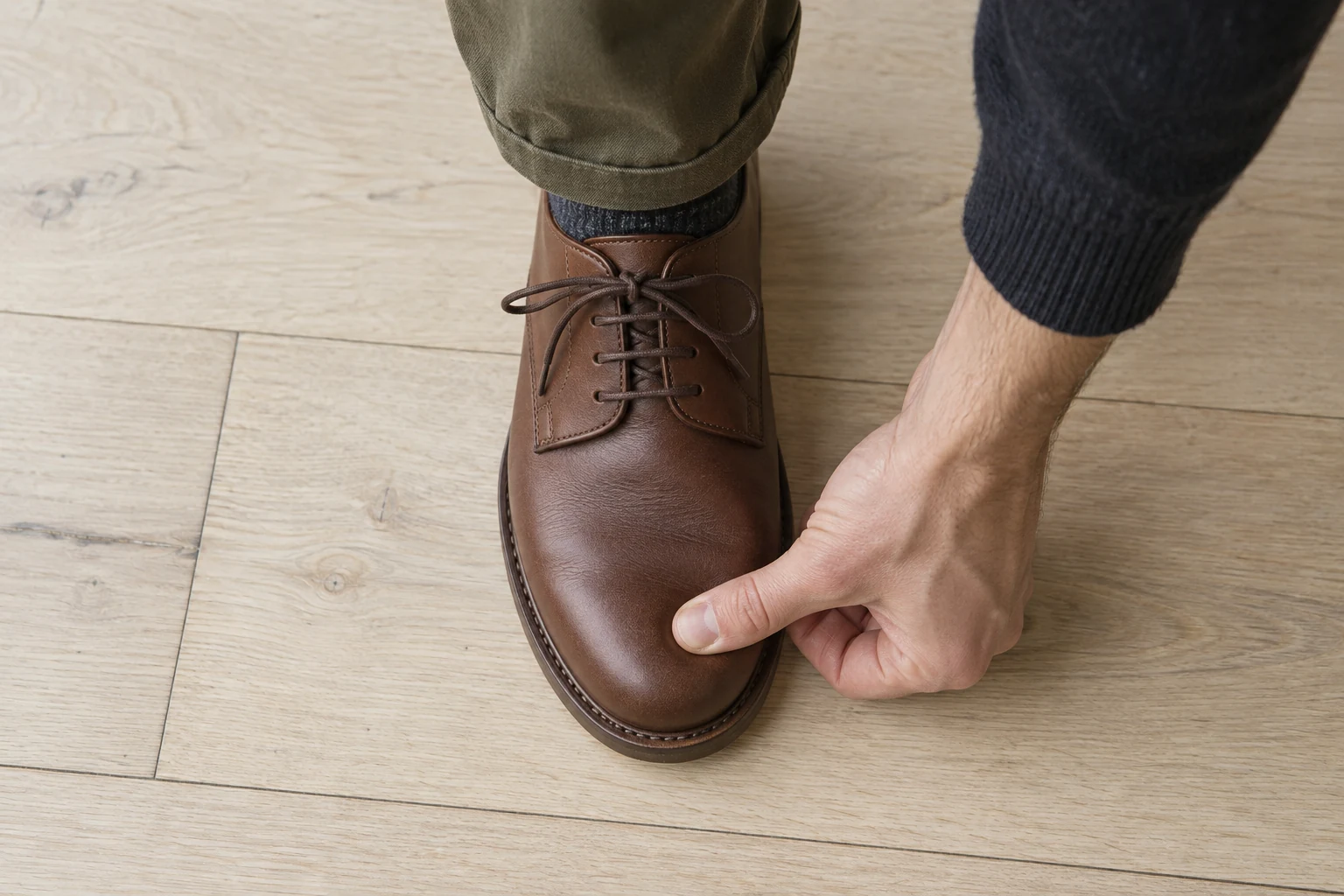
Sizing
How should shoes fit? Toe room, width and heel
How should shoes fit? Check toe room, width and heel grip, learn the signs that shoes are too big or too small, and what changes for running shoes, boots and heels.
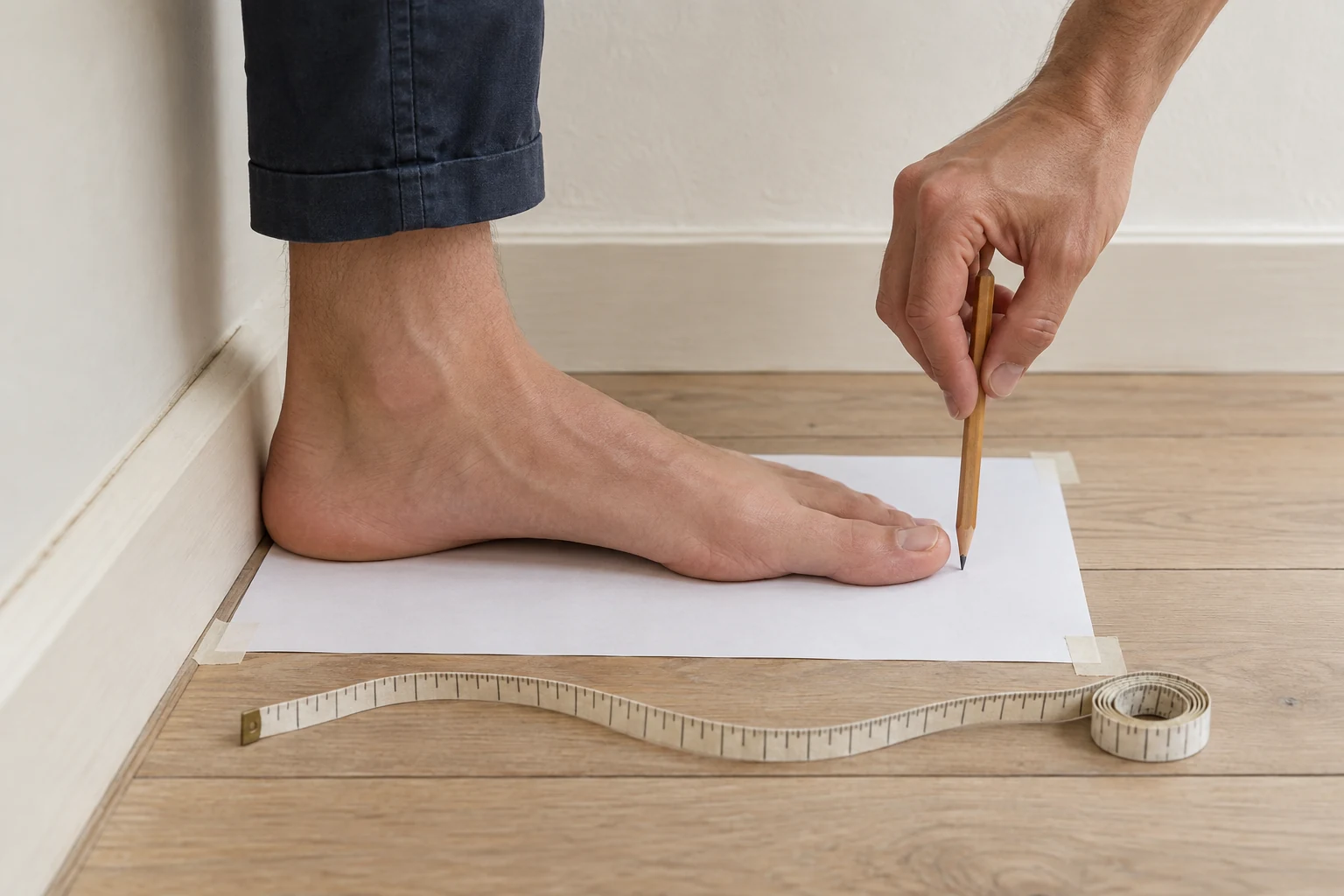
Sizing
Shoe size conversion: US, UK and EU for men and women
Convert shoe sizes between US men's and women's, UK and EU, see why conversion charts disagree, and measure your foot so you can pick the right size in any brand.
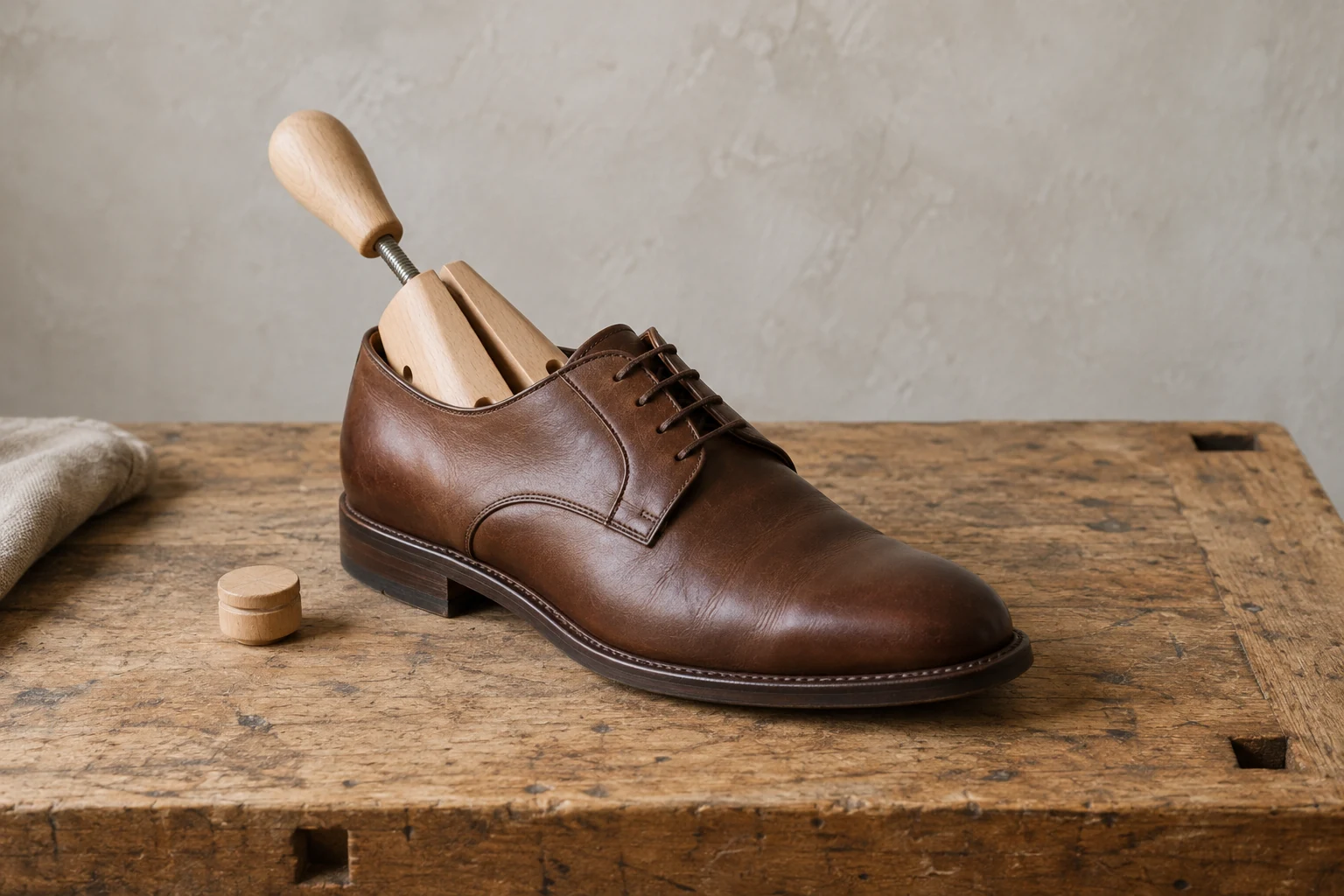
Shoes and jewelry
How to stretch shoes that feel too tight
How to stretch shoes that pinch: what leather can and cannot do, using a shoe stretcher and thick socks, the risks of heat and ice, and when to see a cobbler.
Sizing
How to measure your waist and hips for clothes
Where your waist really is, how to measure your waist and hips accurately, how pants and jeans sizing differs, and how to read a size chart before you order.
Shoes and jewelry
How to lace shoes: straight bar, criss cross and more
How to lace shoes for the job: criss cross for sneakers, straight bar lacing for dress shoes, a heel lock against slipping, and a bow knot that stays tied.