How to measure bra size at home
In this guide
The bra you bought in your usual size rides up at the back by lunchtime, or the cups wrinkle, or the wire sits on tissue instead of behind it. You have a soft tape measure, a mirror and ten quiet minutes. Learning how to measure bra size at home takes exactly that, and it gives you two numbers that point to a sensible place to start.
What the tape cannot do is guarantee a fit. Researchers at the University of Portsmouth, who study breast support, found that the traditional tape method tends to overestimate the band and underestimate the cup, and bra makers cut their patterns differently. So this guide treats measuring as the first half of the job. The second half is trying the bra on and reading what it tells you.
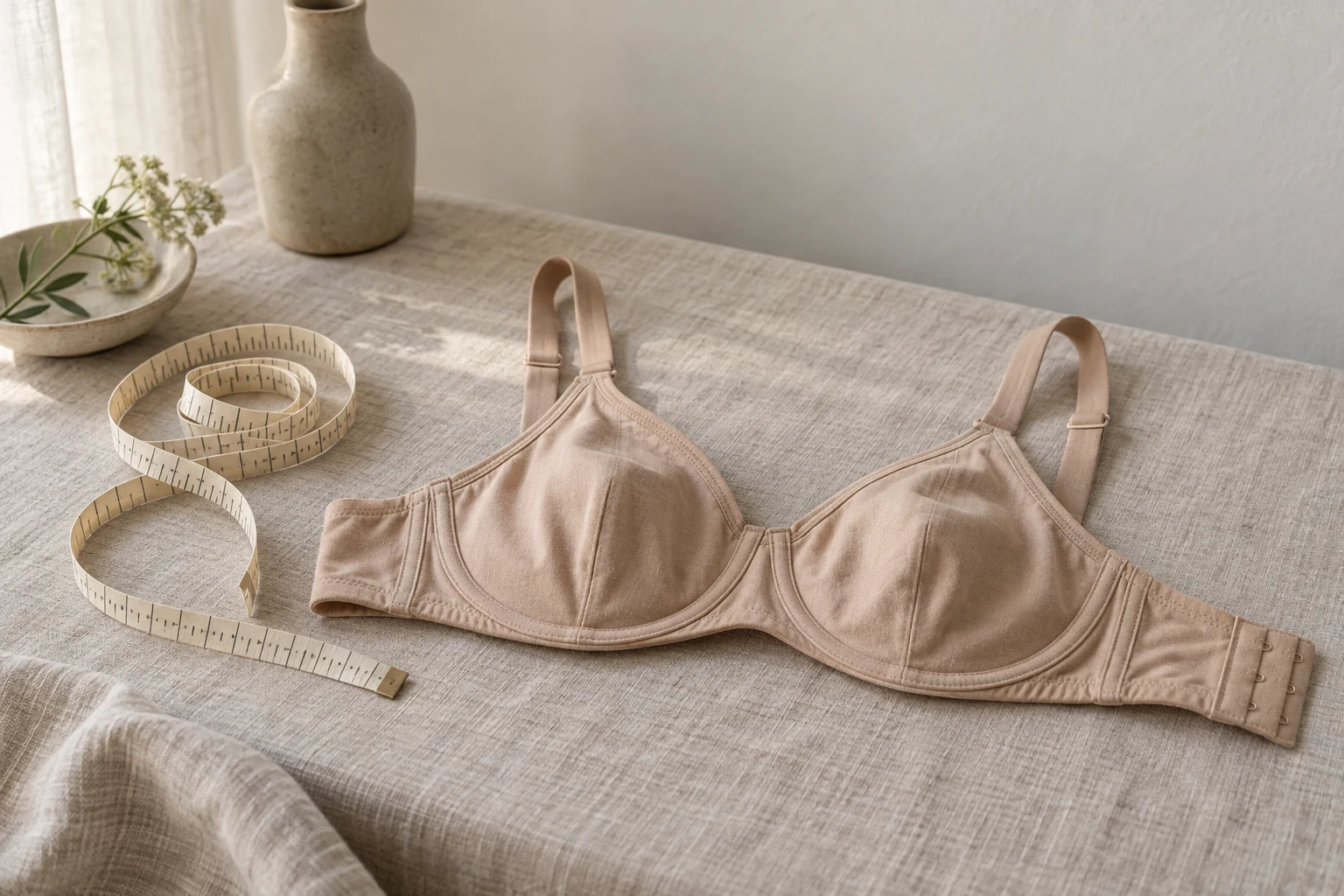
Set up before you measure
Use a flexible sewing tape, not a metal one, and stand in front of a mirror so you can see your back. Wear a bra without padding or with only light lining, as Wacoal advises; molded foam adds its own thickness to the bust measurement and makes the cup look larger than the breast inside it. If you have no unpadded bra, measure without one, and expect the bust number to be less reliable if your breasts are soft or sit low.
Stand straight with your arms relaxed at your sides and breathe normally. Holding your breath or lifting your arms expands the ribcage and changes the band reading. The single most useful thing you can do is keep the tape level all the way around, which is much easier with the mirror or a second pair of hands. A tape that dips at the back or climbs toward the shoulder blades is the most common source of a wrong number. The same habits of a level tape and relaxed posture apply when you are measuring yourself for other clothes.
How to measure bra size step by step
You need two measurements in inches: one where the band of a bra sits, and one around the fullest part of the bust. Write each down before you take the next, and repeat both once so a slipped tape shows up as two numbers that disagree.
Measure your band
Wrap the tape around your ribcage directly under your bust, where a bra band sits. Pull it snug against the skin so it will not slide, but not so tight that it bites. Check in the mirror that it runs parallel to the floor at the back. This number is your underbust measurement.
Measure your bust
Keep the tape at the same height across your back and bring it up around the fullest part of your bust, which for many people is across the nipples. This time hold it loosely: it should rest on the breast without flattening it. Wacoal notes that pulling this tape tight is the error most likely to make a home measurement come out a cup too small.
Take a leaning measurement if your breasts are soft
Some fitters also measure the bust while you bend forward from the hips until your back is roughly level with the floor, which lets soft or lower breast tissue hang free. If this reading is clearly larger than the standing one, the standing number is probably understating your cup, and it is worth trying the next cup up as well.
Work out your band and cup size from the numbers
Your band size comes from the underbust measurement. Many US brands now use it almost directly, rounding to the nearest even number because bands are made in even sizes. Older American guides added 4 or 5 inches to the underbust, a habit many fitters abandoned because it produced bands that were too loose. Check which convention your brand's chart uses before you settle on a number, since the same body can come out two sizes apart.
To find your cup, subtract the underbust from the bust measurement. In US and UK sizing each inch of difference is roughly one cup: about 1 inch is an A, 2 a B, 3 a C and 4 a D. Past D the letters split. US brands usually continue with DD and DDD, sometimes calling the next step F, while UK brands run DD, E, F, FF and onward. A UK F and a US F are therefore not the same cup, and the gap grows with every letter.
European labels work in centimeters. The band number is the underbust rounded into 5 cm steps, and Wacoal's Asian size guide pairs a 75 band with a 34 and a 70 with a 32. Cups there grow in steps of about 2 cm rather than an inch, so letters drift out of line as the cup gets bigger. When you are converting between systems, use the specific brand's own conversion chart rather than a generic bra size chart.
| Bust minus underbust | US cup | UK cup |
|---|---|---|
| About 1 inch | A | A |
| 2 inches | B | B |
| 3 inches | C | C |
| 4 inches | D | D |
| 5 inches | DD | DD |
| 6 inches | DDD | E |
Past D the systems drift apart, so use each brand's own chart when converting.
Why the tape is only a starting point
A tape measures circumference. It cannot see whether your breasts are full at the top or the bottom, set wide or close together, or rooted on a narrow or broad base, and those things decide which cup shape holds you comfortably. The Portsmouth researchers recommend judging fit by how the bra sits on the body, not by the number the tape produced, and they point out that you may be a different size in different brands.
So think of your calculated size as the middle of a small search. Try it, then try the sizes on either side of it, and pay most attention to the band, because makers such as Wacoal describe the band as doing most of the supporting work. A bra with the right band and slightly imperfect cups can be adjusted by going up or down a cup; a bra with a band that floats or rides up cannot be rescued by the straps.
Use sister sizes when the band or cups feel wrong
Cup letters are not fixed volumes. A D cup on a 32 band holds less than a D cup on a 36 band, because the cup grows with the band. That is why sister sizes exist: if you go down one band size and up one cup letter, you keep roughly the same cup volume on a firmer band, so a 34C becomes a 32D. Going the other way, up one band and down one cup, turns a 34C into a 36B.
Use sister sizes to solve band problems without losing a cup that fits. If the cups feel right but the band rides up even on the loosest hook, try the sister size with the smaller band. If the band leaves deep marks while the cups are fine, try the larger band with the smaller letter. The rule holds best within one style, since a different wire shape or cup depth can still change how the sister size feels.
Check the fit in the mirror
Put the new bra on fastened on the loosest hook, lean forward slightly and settle each breast into its cup with your hand, then stand up and adjust the straps. Bands stretch with wear, so starting on the loosest hook leaves the tighter ones for later in the bra's life. Now look at five places, the same ones the Portsmouth group and Wacoal use, and finish by pulling on a close fitting T shirt, just as you would when you check the fit of a dress, to see whether the cup edges and band show through.
The band
It should run level from front to back and stay put when you lift your arms over your head. You should be able to slide two fingers under it at the back with light resistance. If it climbs up your back, it is too big; if it pinches or leaves a bulge, it is too small.
The cups
The breast should fill the cup smoothly, with no tissue spilling over the top edge or out at the sides and no wrinkled or empty fabric. Spilling calls for a larger cup, gaping for a smaller one or a different shape.
The center
The panel between the cups, called the gore, should lie flat on your breastbone. If it stands away from your chest, the cups are usually too small.
The wires
Underwires should follow the crease where the breast meets the chest and sit on the ribcage, not on breast tissue at the sides or underneath.
The straps
They should stay on your shoulders without digging in. If you have tightened them to hold everything up, the band is doing too little, which usually points back to a smaller band.
Common mistakes
Pulling the bust tape tight
The band tape should be snug, but the bust tape should only rest on the breast. Pulling it tight shrinks the difference between the two numbers and can knock a whole cup off the result.
Fixing a loose band with the straps
Shortening the straps to stop a band from riding up moves the weight onto your shoulders and leaves the real problem in place. Try a smaller band, using a sister size to keep the cup volume.
Starting a new bra on the tightest hook
A new band that only feels secure on the tightest hook will be loose once the elastic relaxes. Choose the size that fits on the loosest hook so you can tighten it as it stretches, and slow the stretching by washing gently. Our guide to washing a bra explains what the elastic tolerates, and our guide to hand washing clothes covers the method.
Questions people ask
How do I know my bra cup size without measuring?
There is no dependable way to read cup size by eye or by hand, because cup volume changes with band size and breast shape. The closest substitute is a bra that almost fits: note where it goes wrong, then adjust with the fit checks above, a cup up for spilling and a cup down for gaping. A professional fitting in a lingerie store is the other reliable route.
Why is my bra size different in every brand?
Each maker cuts its own patterns and wire shapes, and some still use older band conventions. The same measurements can therefore land on different labels. Use each brand's own chart and the fit checks rather than assuming one size travels everywhere.
Is a 36C bigger than a 34C?
Yes, in both band and cup. The 36 band is about 2 inches longer, and because cup volume grows with the band, a C cup on a 36 holds more than a C cup on a 34. By the sister size rule, a 36C has roughly the cup volume of a 34D, just on a looser band. So if a 34C band fits but the cups feel small, the answer is usually a 34D, not a 36C.
How do I convert a bra size between US, UK and European labels?
Band numbers usually translate predictably, with a European 75 commonly matched to a US or UK 34. Cup letters are where systems disagree, especially above D, so use the conversion chart published by the brand you are buying. If a brand gives no chart, compare your underbust and bust measurements with its measurement table directly.
How often should I measure my bra size again?
Wacoal suggests every six to twelve months, and after any weight change, pregnancy or breastfeeding. The band is the part that tends to change most. Remeasuring is also worthwhile any time a bra that used to fit starts riding up or digging in.
Sources and further reading
References used for this guide. Each opens the original page in a new tab.
- Wacoal America bra fit calculator and measuring instructions Opens in a new tab
- University of Portsmouth: expert advice on finding a well fitting bra Opens in a new tab
- ThirdLove: how band and bust measurements become a cup size Opens in a new tab
- Wacoal Singapore size guide with band and cup conversions Opens in a new tab
- Wacoal Singapore: how to measure bra size, fit checks and size conversion Opens in a new tab
- Wacoal America: the five points of bra fit Opens in a new tab
Keep reading
Sizing
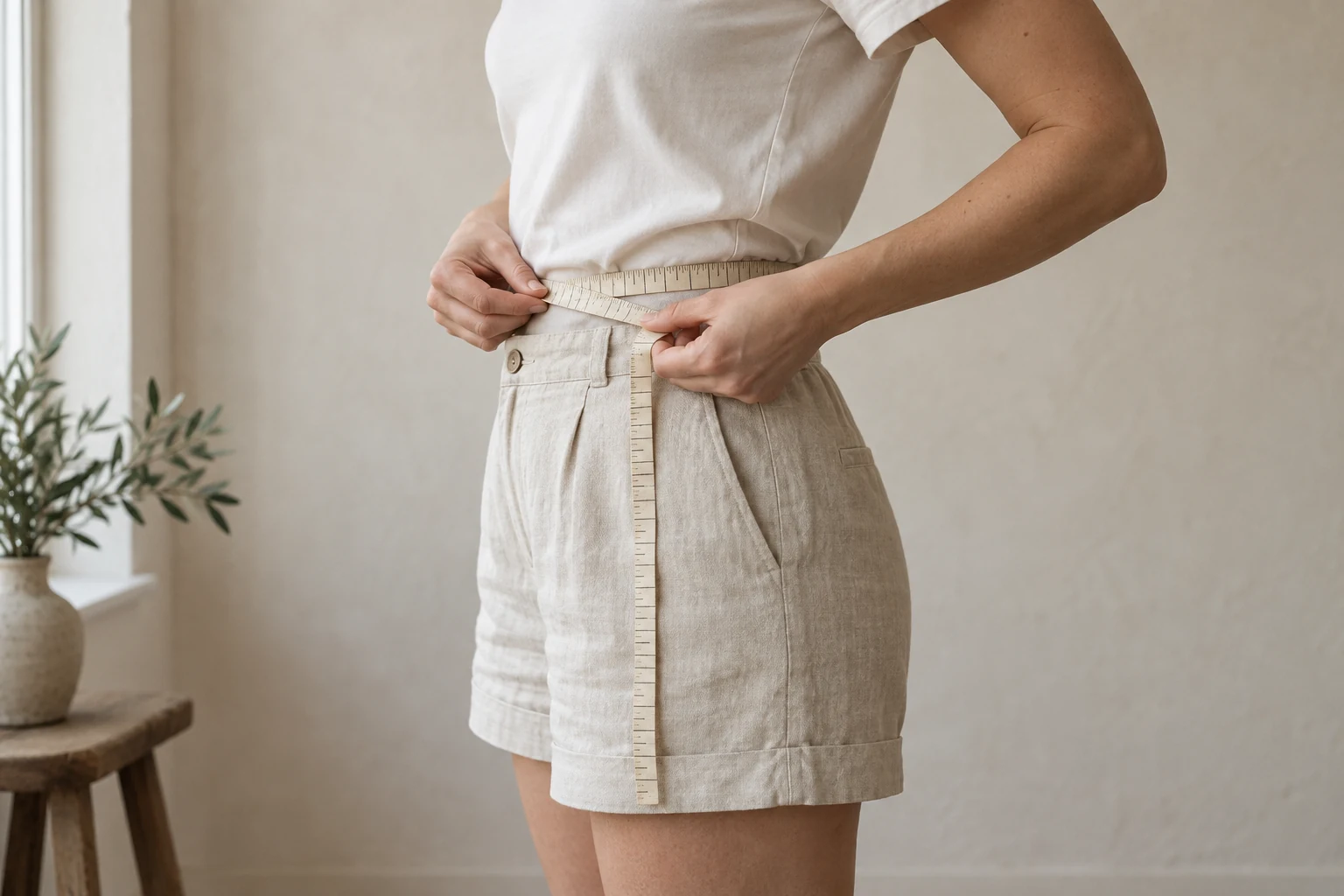
How to measure your waist and hips for clothes
Where your waist really is, how to measure your waist and hips accurately, how pants and jeans sizing differs, and how to read a size chart before you order.
Everyday style
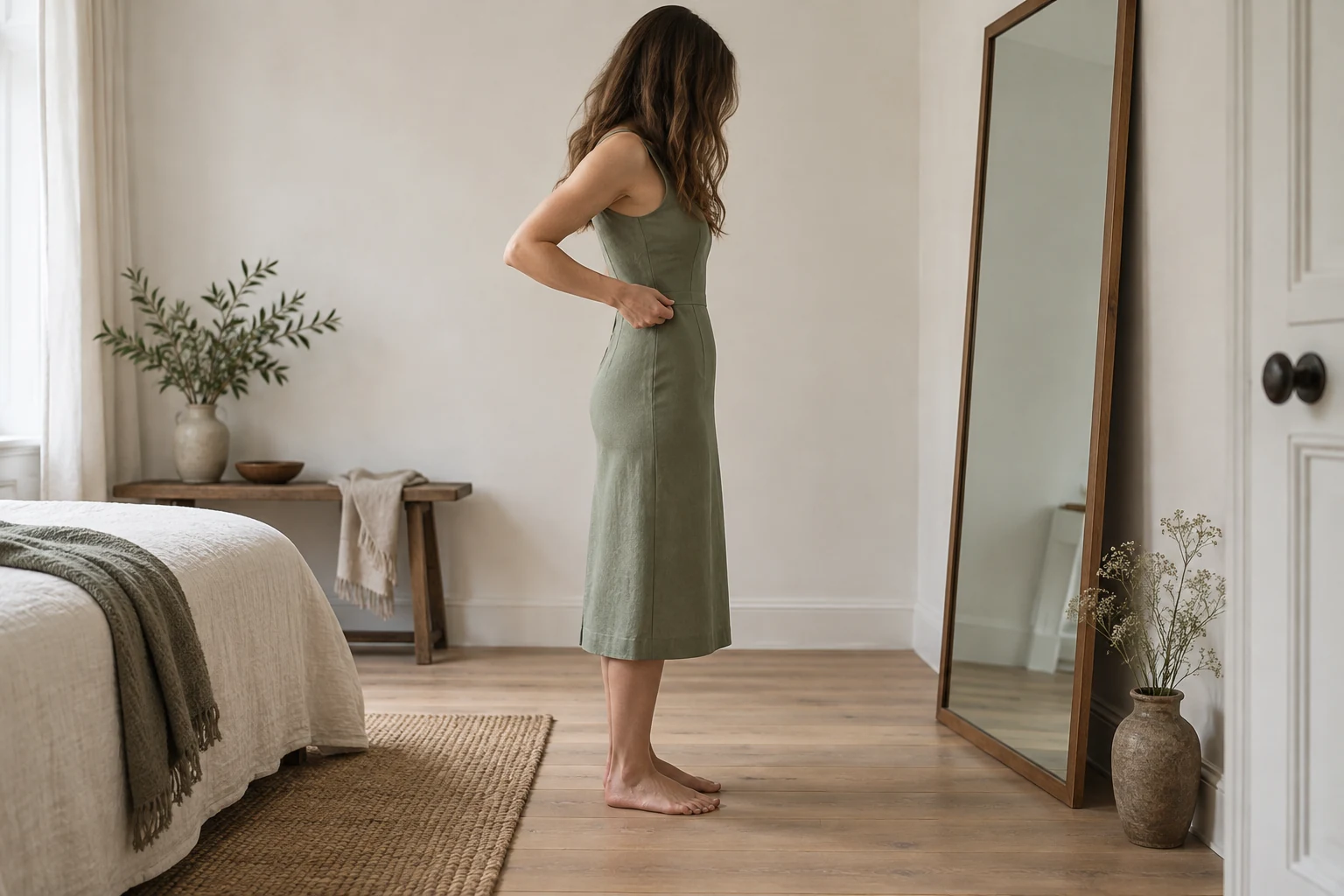
How to check dress fit, from shoulders to hem
How to check dress fit in a fitting room or at home: what to look for at the shoulders, bust, waist, hips and hem, how to read wrinkles, and what a tailor can fix.
Washing and ironing
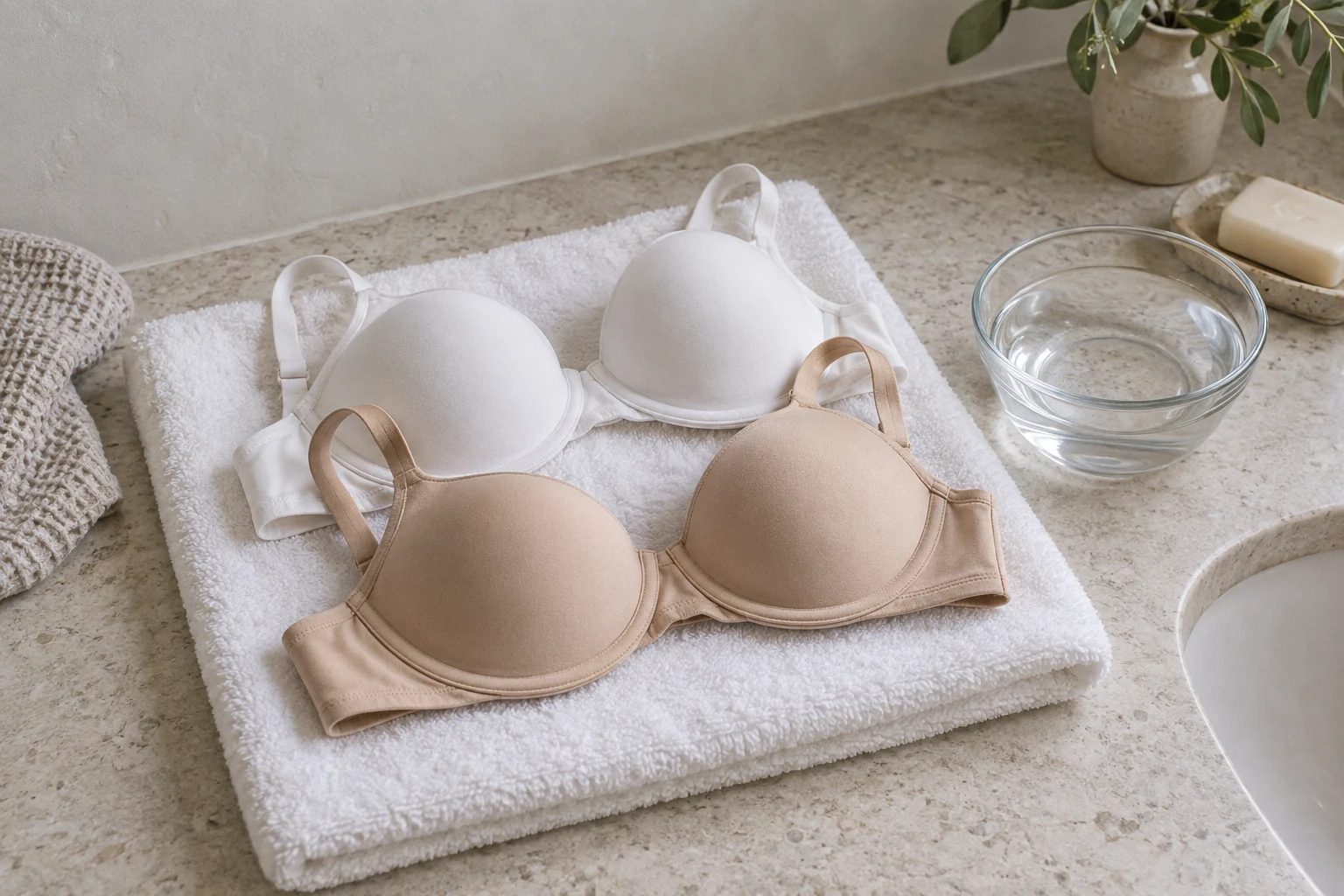
How to wash a bra by hand or in the machine
How to wash a bra by hand or in a washing machine: how often, water temperature, mesh bags and hooks, padded and underwire bras, and why bras never go in the dryer.

Washing and ironing
How to hand wash clothes properly
How to hand wash clothes in a sink or basin: which detergent to use, water temperature by fabric, how long to soak, how to rinse and how to dry without stretching.

Everyday style
How to dress for your body type without the rules
How to dress for your body type using fit, proportion and balance as tools, not rules. What shape labels and Kibbe can tell you, and where they stop helping.