Corduroy: wales, care and how to wear it
In this guide
The first cool week of fall arrives, and a pair of corduroy trousers or an old cord jacket suddenly looks like the most sensible thing in the closet. Corduroy has that effect: it is soft, warm and a little nostalgic, and it keeps coming back into fashion because it is genuinely comfortable. It also raises practical questions. Which wale is right for trousers? Will it look like the 1970s? Why did the knees go bald? What ruins it in the wash?
This guide explains what corduroy is and how it is made, how wale counts change the look, how to wear corduroy pants, jackets and shirts today, and how to care for it so the pile stays plush.
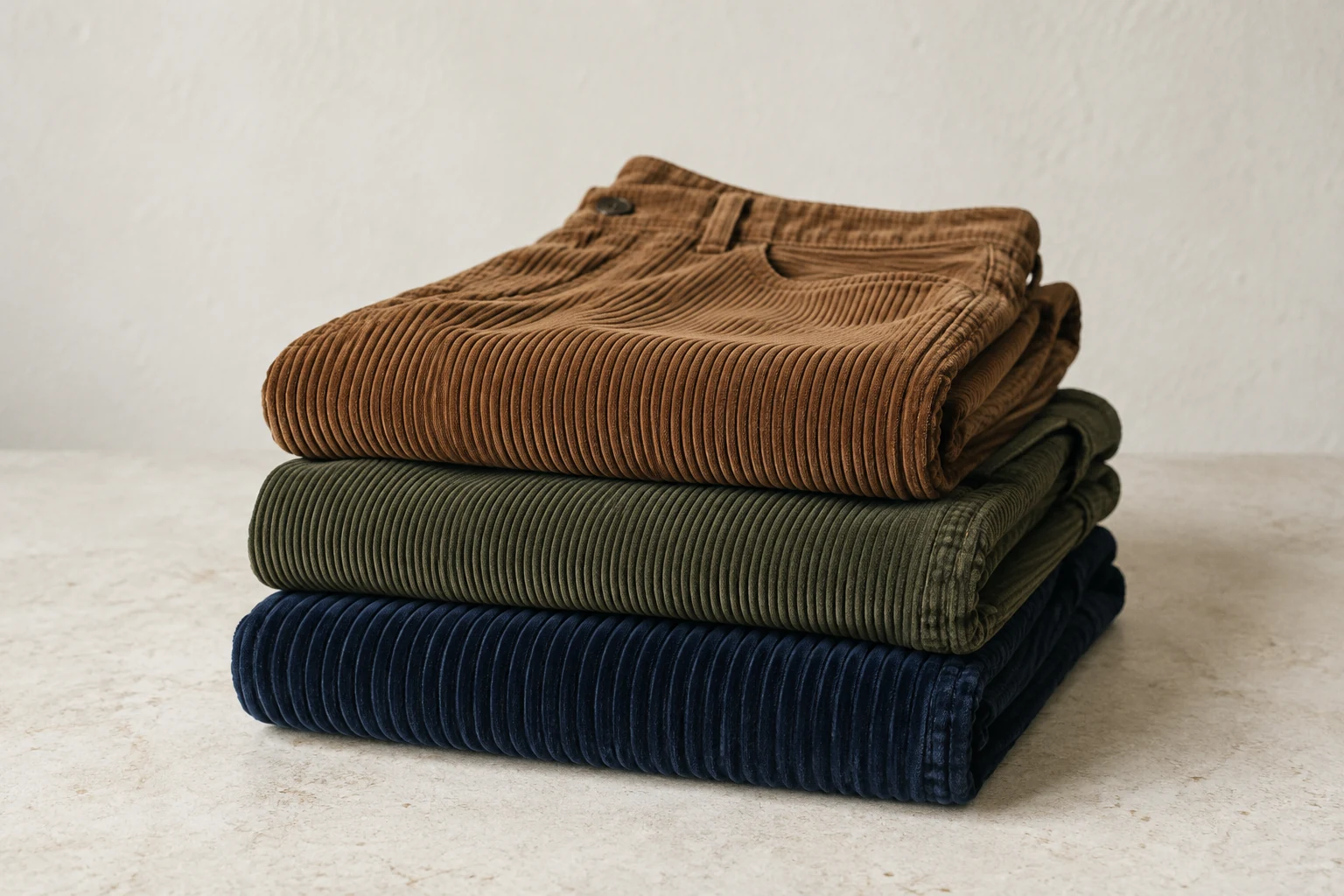
What corduroy fabric is and how it is made
Corduroy is a pile fabric, a close relative of velvet, and both descend from fustian, a family of sturdy cotton and linen cloths woven in Europe for centuries. It is woven with a base cloth plus extra sets of crosswise yarns that float over several lengthwise threads in lines. After weaving, those floats are cut, and the cut ends are brushed up into soft tufts. Lined up, the tufts form the raised ridges, called wales or cords, with narrow channels between them.
Most corduroy is 100% cotton or cotton with a little elastane for stretch, though you will also see wool, polyester and blends. The popular story that the name comes from the French corde du roi, the cord of the king, is almost certainly a later invention; the real origin of the word is uncertain. Corduroy was worn in Europe from the eighteenth century, mostly as tough workwear, and became a mainstream fashion fabric in the twentieth century, peaking in the 1970s.
Wale counts: pinwale, standard and wide wale
Corduroy is described by its wale count, the number of ridges per inch (2.5 cm). The higher the number, the finer the cord. Makers draw the lines slightly differently, but roughly: fine cords, sold as pinwale, needlecord or feathercord, have 16 or more wales per inch and look almost smooth from a distance; standard or regular wale, the classic trouser cord, sits around 10 to 14; wide wale is about 6 to 10; and jumbo or broad wale drops to 3 to 5, with thick ridges you can feel with a fingertip.
The count changes where a piece belongs. Fine cords drape well and look refined enough for shirts, dresses and tailored trousers that can go to an office. Standard wale is the all rounder for trousers and jackets. Wide wale reads chunky, casual and a bit retro, and it is also the corduroy of sofas and upholstery. If you want one pair of corduroy pants that goes almost anywhere, a standard or fine wale in a mid tone is the safest choice.
| Wale | Ridges per inch | Best for |
|---|---|---|
| Pinwale, needlecord or feathercord | 16 or more | Shirts, dresses and office trousers |
| Standard or regular | About 10 to 14 | The all rounder for trousers and jackets |
| Wide wale | About 6 to 10 | Chunky, casual, a little retro; upholstery |
| Jumbo or broad wale | 3 to 5 | Thick ridges you can feel; strong statements |
One pair that goes almost anywhere: standard or fine wale in a mid tone.
How to wear corduroy pants
For men, corduroy pants take the place of chinos from October to March. Good colors are tobacco brown, olive, navy, burgundy, stone and charcoal. Wear them with an oxford shirt and a crew neck sweater, a flannel shirt and boots, or a navy blazer and loafers for a relaxed smart casual look. Straight or gently tapered legs look current; very slim or very skinny cords can look dated. Match the texture elsewhere, with wool, tweed or suede, rather than shiny fabrics.
Corduroy pants women wear range from high waisted wide legs, which look polished with a tucked fine knit and ankle boots, to straight or flared cuts with a T shirt and a trench coat. Wide wale reads more 1970s, so if you want to avoid a costume effect, keep the rest of the outfit modern and simple: clean white sneakers or loafers, a plain top, one accessory. Our guide to styling wide leg trousers covers proportions that also apply to wide cords.
Corduroy jackets and shirts
A corduroy jacket is one of the most useful layers for fall. For men, a brown or olive cord sport coat over a knit and chinos is a softer alternative to a tweed jacket, and a cord trucker or chore jacket is a weekend piece that goes with jeans. For women, a cropped cord jacket or a relaxed cord blazer pairs well with straight jeans and a fine knit, and a longer cord coat works over dresses. Avoid a matching corduroy jacket and trousers unless it is a deliberate suit in a fine wale.
Corduroy shirts, usually in fine wale, sit between a flannel shirt and an overshirt. Wear one alone with chinos, or open over a T shirt as a light jacket on a cool afternoon. A burgundy or dark green cord shirt with gray trousers is a comfortable way into the look if you are unsure; the texture adds interest without the color doing too much.
Is corduroy dated, and is it for summer?
Corduroy has strong associations with the 1970s, from wide wale flares to tan blazers, and it cycles in and out of fashion. But fine and standard wale in good colors never really leave. What dates corduroy is not the fabric but the combinations: very wide wales, orange or mustard tones worn head to toe, heavy flares. Wear one corduroy piece at a time, choose neutral or deep colors and pair it with modern shapes, and it looks current in any year.
Corduroy is mainly a cool weather fabric. The pile traps air, which makes it warm, and heavier cords are uncomfortable once the temperature passes about 70°F (21°C). Lightweight fine wale cotton cords can work for cool spring and summer evenings, but for real heat choose linen, seersucker or light cotton. Our guide to what to wear in 50 degree weather is a good fit for corduroy season.
How to wash corduroy and what ruins it
Corduroy is usually easy to launder at home, but the pile needs a little respect. Turn the garment inside out so the wales do not rub against the drum and other clothes, and wash it with similar colors in cool or warm water on a gentle or normal cycle. Keep it away from towels and fleece, which shed lint that lodges between the cords. Too much heat, harsh agitation and overloading are what flatten and wear the pile.
Dry on low heat and remove while still slightly damp, then smooth the wales by hand in the direction of the pile and let it finish drying on a hanger. Ironing is best avoided: pressing the face crushes the pile and can leave shine. If you must, iron on the reverse side over a thick towel, or steam from inside. Bald patches at the knees and seat are wear, not dirt, and cannot really be reversed, so rotate your cords and avoid rough surfaces. For other textured fabrics, see our guide to steaming clothes.
Common mistakes
Ironing the front
A hot iron on the face of corduroy crushes the pile and leaves shiny, flat lines. Steam from inside or iron the reverse on a thick towel so the wales stay raised.
Washing with towels
Terry towels and fleece shed lint that settles into the channels between wales and is hard to remove. Wash corduroy inside out with smooth fabrics, and use a lint roller or soft brush along the wales if it happens.
Drying it bone dry on high heat
High heat can shrink cotton corduroy and leaves the pile matted and stiff. Use a low setting, remove it slightly damp and let it hang to finish.
Questions people ask
What kind of material is corduroy?
Corduroy is a woven pile fabric, usually cotton or cotton with a little stretch, with raised ridges of cut pile running lengthwise. It is related to velvet, which uses the same cut pile idea across the whole surface instead of in lines.
Why is corduroy so expensive?
Good corduroy uses extra yarn for the pile and needs additional steps after weaving: cutting the floats, brushing and finishing the wales. Dense, fine wale cords in quality cotton take more yarn and care than a plain chino, which shows in the price. Cheaper cords tend to have thinner pile that wears bald sooner.
Is corduroy warm?
Yes, it is one of the warmer cotton fabrics because the pile traps a layer of air. Standard and wide wale cords are comfortable in cool fall and winter weather, especially with a thermal or wool layer underneath on very cold days.
What is the difference between corduroy and velvet?
Both are cut pile fabrics, but velvet has an even pile over the whole surface, which gives a smooth, lustrous finish. Corduroy's pile is arranged in parallel ridges with channels between them, giving a matte, ribbed texture that is sturdier and more casual.
Sources and further reading
References used for this guide. Each opens the original page in a new tab.
Keep reading
Fabrics
What is tweed? The fabric explained, and how to wear it
What tweed fabric is, how it got its name, the main types from Harris to Donegal, whether it itches or sheds rain, and how to wear and care for it.
Fabrics
What is twill fabric, and what is it good for
What is twill? The weave behind jeans, chinos and gabardine: how to spot the diagonal, what twill is made of, where it works, and how it compares to cotton.

Weather
What to wear in 50 degree weather
50°F can feel like spring in the sun and like late fall in the wind. How to match the jacket to the day, what to wear under it, and outfits for men and women.
Everyday style
How to style wide leg pants: tops, shoes and hems
How to style wide leg pants with the right tops, shoes and hem length, for work and weekends, with practical fixes for pants that drag, swamp you or feel sloppy.
Fabrics
Oxford cloth: why the oxford shirt works everywhere
What an oxford cloth shirt is: the basketweave, oxford vs pinpoint and royal oxford, how it compares to a dress shirt, how to wear it and how to care for it.