How to roll up shirt sleeves so they stay
In this guide
Most sleeves get rolled in a hurry: the cuff comes undone on a warm afternoon, the fabric gets shoved up the forearm, and within an hour it has slid back down in crumpled rings. A few deliberate folds fix that. The same shirt looks formal with buttoned cuffs and relaxed with neatly rolled sleeves, and in a warm office or on a summer evening it is simply more comfortable.
This guide shows how to roll up shirt sleeves three ways, from the neat Italian roll that stays put all day to the quick classic roll, then covers button tabs, French cuffs, T shirts and when rolled sleeves are and are not appropriate. Everything works the same for men's and women's shirts.

Before you roll: unbutton everything
Every method starts the same way. Undo the cuff button and also the small button on the sleeve placket, the slit above the cuff, if your shirt has one. That second button is easy to miss, and leaving it fastened keeps the cuff narrow, which makes the roll tight on the forearm and pulls the fabric crooked. If the cuff has two buttons for adjusting its width, undo both.
Height is the other decision. The conventional finish is just below the elbow, which leaves the forearm free and lets the elbow bend without pulling. Rolling above the elbow is more casual and works for hot weather or physical work, while a roll of two or three turns just above the wrist is the most polished and suits a shirt worn under a sweater vest. Fabric matters too: crisp poplin holds a sharp roll, softer oxford cloth and linen give a relaxed one, and a very thick flannel is better with only two turns.
How to roll up your sleeves Italian style
The Italian roll, also called the master roll, is the one many shirtmakers recommend. It uses only two folds, so it is less bulky than a stack of turns, it grips the arm without squeezing, and it leaves a neat strip of the cuff showing. UNTUCKit and Savile Row Company both describe it the same way. Do it on one arm, then match the other.
Flip the cuff inside out
With the cuff and placket unbuttoned, fold the cuff back over the outside of the sleeve so its inside faces out. You should see the lining side of the cuff lying on your forearm, its wrist edge now pointing toward your elbow.
Pull the fold up to below the elbow
Without rolling, slide that doubled section up your arm until the top of the inverted cuff reaches just below the elbow, or just above it for a more casual look. The sleeve fabric below the cuff is now doubled over itself in one long fold.
Fold the bottom edge up once
Take the bottom edge of that long fold and fold it up over the lower part of the cuff, stopping about half an inch to an inch (1 to 2.5 cm) short of the cuff's top edge. You should see a clean band of sleeve with a narrow strip of cuff peeking out above it.
Tuck and smooth
Tuck any loose corner of the cuff under the band and smooth the fabric around the arm. Bend your elbow a few times; the roll should stay in place without pinching.
The classic roll, fast and simple
The classic or basic roll is what most people do by instinct, done more carefully. Unbutton the cuff and placket, fold the cuff back on itself so the fold is exactly the width of the cuff, then fold again by the same width, and repeat two or three times until the roll sits where you want it. Keeping each turn the same width is what makes it look deliberate instead of bunched. Savile Row Company suggests it for casual settings and hot offices when you want to cool down quickly.
It holds less securely than the Italian roll because every turn can loosen, so it suits shirts you will not wear with a jacket or bag strap pulling at the sleeve. For a slightly more finished version, roll only twice, keeping the whole cuff inside the roll, which hides contrast linings and looks tidy with a sweater vest or suspenders.
The high roll for heat or work
When you need your forearms and elbows completely free, for cooking, gardening or a very hot day, roll above the elbow. Start with the Italian roll and simply pull the first fold higher before making the final fold, so the band sits a couple of inches above the elbow. It holds better than a classic roll pushed high, because the upper arm is wider and grips the folded band.
The high roll is decidedly casual. It suits an oxford shirt, chambray or linen with jeans or shorts, and it looks out of place with a dress shirt and tailored trousers, where a below the elbow roll is enough.
| Roll | How it works | Best for |
|---|---|---|
| Italian roll | Flip the cuff, pull it up, fold the bottom edge once | All day wear; neat and secure |
| Classic roll | Two or three turns, each the width of the cuff | Quick cooling in casual settings |
| Two turn classic | Two turns with the whole cuff hidden inside | A tidy look with a sweater vest |
| High roll | Italian roll pulled above the elbow | Cooking, gardening, very hot days |
| Roll up tab | Two or three turns, then fasten the tab | Shirts with a tab sewn inside the sleeve |
Button tabs, French cuffs and T shirts
Many women's shirts and some utility shirts have roll up tabs: a strip of fabric with a buttonhole sewn inside the sleeve and a button on the outside. Roll the sleeve in two or three even turns to just below the button, bring the tab up over the roll and fasten it, and the sleeve will hold all day. If the tab sits above your chosen height, roll higher or leave the tab tucked inside.
French cuffs are made for cufflinks, and cufflinks are made for formal dress, so rolling them is uncommon. If you must, remove the cufflinks first and do a simple two turn classic roll, knowing the double cuff will be bulky; our guide to wearing cufflinks covers the cuff itself. For T shirts, roll the hem up twice in narrow turns, a quarter to half an inch (6 to 12 mm) each, and press the fold with your fingers. A heavier T shirt holds best; with thin cotton, a stitch or two at the side seam fixes the roll for good.
How to roll up shirt sleeves so they stay
If rolls keep sliding down, the cause is usually the cuff button still fastened, a slippery fabric, or turns that are too narrow for the arm. Unbutton fully, use the Italian roll, and set the band slightly higher than where you want it to end up, since it settles as you move. A quick press of the roll with an iron or steamer, if you roll the same shirt often, gives the folds a memory; our guide to ironing a shirt shows how to handle the cuff.
Sleeve length matters too. A sleeve that is much too long bunches and slides; one that is short barely rolls at all. If your shirts always fight you, check the sleeve length using our guide to measuring sleeve length.
When rolled sleeves are appropriate
Rolled sleeves say you are at work or at ease, and that is where they belong: in a warm office, at a casual dinner, at a summer party, or with the tie loosened late in the day. They read as relaxed with an oxford shirt and jeans, and as smart casual with a crisp shirt and chinos, as described in our guide to smart casual.
They are not worn under a jacket; the sleeve bunches inside and the cuff should show slightly below the jacket sleeve instead. Keep sleeves buttoned at formal events, interviews, funerals and conservative business meetings, and whenever you wear cufflinks. When you take off your jacket at a wedding or a dinner, following the host's lead before rolling up is a small courtesy.
Common mistakes
Leaving the placket button fastened
The cuff stays narrow and the roll twists and squeezes the arm. Undo both buttons before you start.
Uneven turns
Folds of different widths look sloppy and loosen fast. Match each turn to the width of the cuff.
Rolling under a jacket
Sleeves bunch inside the jacket and wrinkle badly. Roll only once the jacket is off.
Questions people ask
Which roll is best for a dress shirt?
The Italian or master roll. It uses fewer folds, holds all day, stays neat and shows a little of the cuff, which looks especially good when the cuff has a contrast lining. The classic roll is fine for a quick fix.
How high should you roll your sleeves?
Just below the elbow is the standard, balanced height. Above the elbow is more casual and practical for heat or work, and a short roll just above the wrist looks the most polished.
Do rolled sleeves look good on women's shirts?
Yes, and they often look better, because a slightly oversized women's shirt with rolled sleeves shows the wrist and forearm and balances the loose fit. Button tabs make it easy, and the Italian roll works just as well on shirts without them.
Should the cuff show when you roll your sleeves?
It is a matter of taste. The Italian roll shows a narrow strip of cuff by design, while a classic roll hides it. Showing it looks more deliberate, and hiding it looks cleaner under a sweater vest.
Sources and further reading
References used for this guide. Each opens the original page in a new tab.
Keep reading
Washing and ironing
How to iron a shirt in the right order
How to iron a shirt the way shirtmakers do: set the heat for the fabric, start slightly damp, then work collar, cuffs, sleeves, yoke, back and front in order.
Everyday style
How to tuck in a shirt so it stays put
How to tuck in a shirt so it lies flat and stays in all day: the standard tuck, the military tuck, shirt stays, and when to leave a shirt untucked.
Sizing
How to measure sleeve length for shirts and jackets
How to measure sleeve length on your body or on a shirt you already own, why dress shirts start at the neck and jackets at the shoulder, and how to measure alone.
Dress codes
Smart casual: what it means for men and women
What smart casual really means, how it differs from business casual, and what men and women can wear, including when jeans, sneakers and a blazer are right.
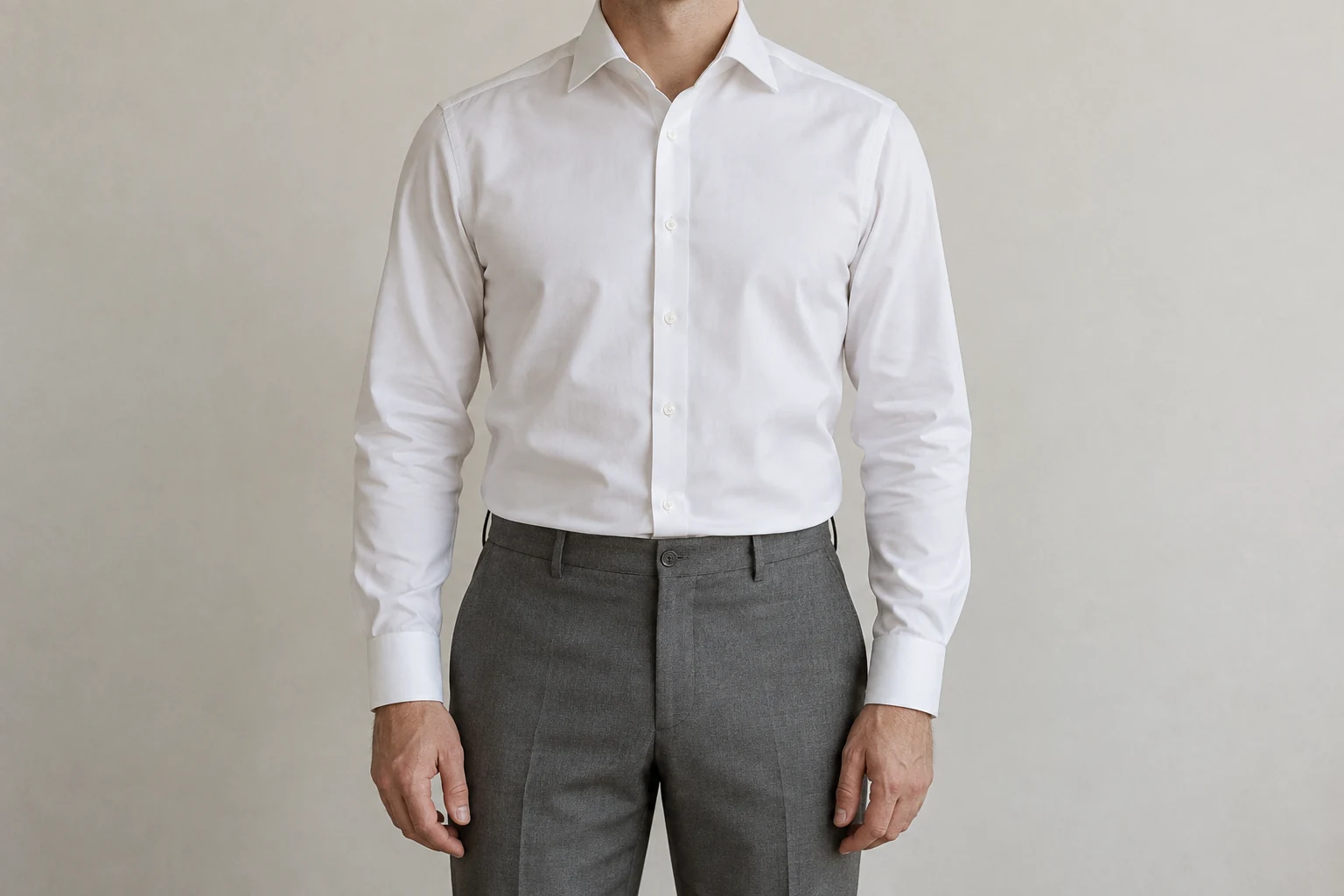
Suits and tailoring
How a dress shirt should fit: collar to cuff
How a dress shirt should fit at the collar, shoulders, chest, waist, sleeves and hem, what slim and classic fit mean, and which problems a tailor can fix.