Laundry symbols explained: how to read a care label
In this guide
A new sweater usually comes with a label in the side seam that shows five small drawings and hardly a word, and you want to know what those laundry symbols mean before the first wash rather than after it. The system is smaller than it looks: five basic shapes, plus three kinds of marks that modify them. Once you can read those eight things, almost every label becomes a short sentence you can follow.
Two closely related systems are in use. In the United States, the Federal Trade Commission's Care Labeling Rule requires clothing to carry care instructions and lets makers use the ASTM D5489 symbols in place of words. Much of the world uses ISO 3758, which grew out of the GINETEX symbols. The shapes are shared, but American labels show temperature with dots, while international labels usually print a number. This guide covers both.
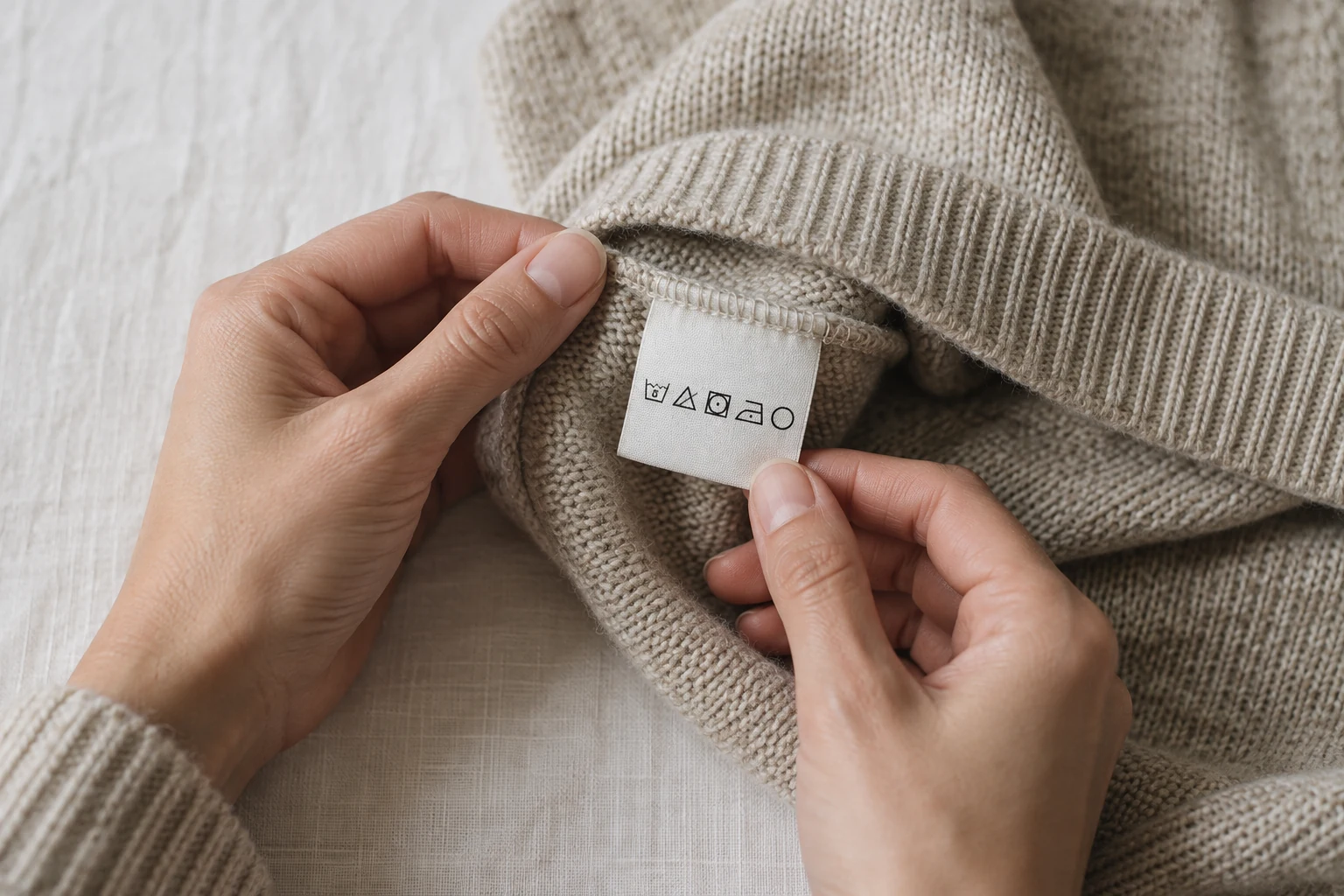
What laundry symbols mean: the five basic shapes
Read a care label from left to right and it usually follows the life of a wash. The tub, a bucket shape with a wavy water line at the top, is washing. The triangle is bleach. The square is drying, in a machine or in the air. The iron, drawn as a household iron seen from the side, is pressing. The circle is professional cleaning, the part of the label meant for a dry cleaner. The ASTM chart lists the first four in that order as the minimum for a washable garment.
The modifiers are just as consistent. Dots stand for temperature, and more dots mean more heat. One or two lines drawn under a symbol ask for a gentler cycle with less agitation. A large cross drawn over any symbol means do not: do not wash, do not bleach, do not tumble dry, do not iron. GINETEX makes one more point that changes how you should read everything else. Each symbol states the most severe treatment the garment can survive without lasting damage, so a lower temperature or a milder cycle is always permitted.
| Shape | Covers | Read the modifiers |
|---|---|---|
| Tub | Washing | Dots for heat, lines for a gentler cycle, a hand for hand wash |
| Triangle | Bleach | Empty any bleach, two diagonal lines non chlorine only |
| Square | Drying | Circle for tumble dry, lines for hang, drip or flat |
| Iron | Pressing | One to three dots for heat, crossed lines below mean no steam |
| Circle | Professional cleaning | Letters are for the cleaner; W means wet cleaning |
A large cross over any shape means do not, and each symbol is a limit, not a target.
The wash tub: temperature and cycle
On an American label, dots inside the tub give the maximum water temperature. One dot is cold, roughly 65 to 85°F (up to 30°C). Two dots are warm, about 105°F (40°C). Three dots are hot, about 120°F (50°C), and four dots are very hot, about 140°F (60°C). An international label prints the Celsius number instead, which is why people search for the machine wash 30 symbol or the 40 laundry symbol. A 30 means no hotter than 30°C (86°F), a 40 means 40°C (104°F), and a 60 means 60°C (140°F). A 95 is a boil wash, meant for sturdy cotton or linen items made to be boiled.
Lines under the tub describe the cycle. In the ASTM system, a plain tub is the normal cycle, one line is the permanent press cycle and two lines are the delicate or gentle cycle. In the ISO system, one bar means a mild process and two bars mean a very mild one, the kind of wool cycle GINETEX pairs with a drum no more than one third full. A hand dipped into the tub means hand wash; the ISO chart limits it to 40°C (104°F), and the 2023 edition also lists a hand wash at room temperature, about 20 to 30°C (68 to 86°F). A tub with a cross through it means do not wash at home at all. For the method itself, see our guide to washing clothes by hand.
The triangle: when bleach is allowed
An empty triangle means any bleach may be used when needed, chlorine or oxygen. A triangle with two diagonal lines inside it means only non chlorine bleach, which in practice means oxygen bleach. A triangle with a cross through it means no bleach of any kind; American labels often draw this one solid black, while the international version is an outline. The FTC rule treats bleach as a required part of a washing instruction, so a label that says nothing about bleach is telling you that all common bleaches are acceptable for regular use.
The triangle matters more than people expect because bleach hides in ordinary products. GINETEX notes that oxygen bleach is contained in many universal detergents, and that colored garments washed in them can change shade when the label forbids bleaching. When the label shows the triangle with two diagonal lines, our guide to using oxygen bleach explains how to dose and test it. If you see the crossed triangle, choose a detergent without bleach and test any stain remover on a hidden seam first. Never mix chlorine bleach with ammonia or with vinegar or other acids, because the combination releases harmful gases. For keeping light clothes bright without guesswork, see how to wash white clothes.
The square: tumble drying and air drying
A circle inside the square means tumble dry. On an American label, an empty circle means any heat, one dot is low, two dots are medium, three dots are high, and a solid filled circle means air only, with no heat. Lines under the square ask for the permanent press or delicate dryer cycle, just as they do under the tub. International labels stop at two dots: one dot is a lower temperature process, about 60°C (140°F), and two dots is normal drying at about 80°C (176°F). A crossed circle in a square means do not tumble dry.
A square with lines and no circle means dry in the air, and here the two systems draw things differently. In the ISO system, a single vertical line means hang to dry on a line or hanger, so the laundry symbol that looks like a square with a vertical line is simply line drying. Two vertical lines mean drip dry, hung up while still wet without spinning or wringing. A single horizontal line means dry flat, and two horizontal lines mean drip flat. A short diagonal line in the top left corner adds in the shade. The ASTM system uses a curved line hanging from the top edge for line dry, three vertical lines for drip dry and one horizontal line for dry flat, with two diagonal lines in the corner for shade.
Dry flat is the instruction most worth obeying. It usually appears on knitwear because the weight of water pulls a hanging knit longer. Our guide to washing a wool sweater shows how to lay one out so it keeps its shape, and our guide to air drying clothes covers line, drip and flat drying for everything else.
The iron: heat and steam
Dots in the iron set the highest sole plate temperature. One dot is low, up to 120°C (248°F), for delicate synthetics such as acetate and acrylic. Two dots are medium, up to 160°C (320°F), for wool, polyester and many blends. Three dots are high, up to 210°C (410°F), for cotton and linen. Those are the figures on the current GINETEX chart; older charts, including the American ASTM chart, give 110, 150 and 200°C (230, 300 and 390°F), which is why two charts found online can disagree by ten degrees. Most home irons mark their dial with the same one, two and three dots, so match the dots and you stay within the limit. An iron with a cross through it means do not iron, and crossed lines drawn under the iron mean no steam.
GINETEX is firm that the temperature should come from the care label, not from the fiber list. A linen blend with a printed finish may carry one dot even though linen alone would take three. When the label allows heat but the fabric is shiny, textured or decorated, press it inside out or under a pressing cloth. Our guide to ironing a shirt covers the order of collar, cuffs, sleeves and body.
The circle: dry cleaning and wet cleaning
A plain circle is the dry cleaning symbol, and the letter inside is for the cleaner rather than for you. In the ASTM chart, A means any solvent, P means perchloroethylene or a petroleum solvent, and F means petroleum solvent only. A line under the circle means the normal process must be modified, for example with less moisture or lower heat. A crossed circle means do not dry clean. International labels use P and F in a similar way and add a W in a circle for professional wet cleaning.
Wet cleaning is done in water, but with professional machines, detergents and finishing that GINETEX says cannot be reproduced in a household washer. A W in a circle is therefore not permission to wash at home. Take the garment to the cleaner with the label intact and tell them about any stains and anything you have already tried on them.
When the label is missing, faded or confusing
Under the FTC rule, instructions must cover the whole garment, including linings, trim, buttons and zippers, and the maker needs reliable evidence that following them causes no substantial harm. That is why a cotton jacket with a fused lining can carry stricter instructions than a cotton shirt. The rule also explains the shortest possible label: machine wash, tumble dry. Those four words mean any water temperature, any dryer heat and any bleach are safe, and that ironing is not needed.
If the label has been cut out or washed blank, look for the exact style on the maker's website, or send the maker a photograph and the product number. Until you know more, treat the piece as delicate: cold water, a gentle cycle or hand wash, no bleach and air drying. That cautious routine rarely harms anything, whereas guessing at heat can shrink a garment for good, the same effect our guide to shrinking clothes on purpose uses deliberately. Photograph new labels before they fade, including any text on the reverse.
Common mistakes
Treating the number as a target
A 40 in the tub is a ceiling, not a recommended setting. Lower temperatures and milder cycles are always allowed, and cooler water is kinder to dyes. Use the full limit only for heavily soiled pieces.
Assuming dry clean means dry clean only
The FTC rule allows a maker to give only one safe method even when others would also work, so a plain dry clean instruction is not proof that water will cause damage. Dry clean only is a stronger warning. If you choose to wash a piece labeled dry clean, you take on the risk, so start with a hidden area and cold water.
Questions people ask
What does the 30 or 40 in the wash tub mean?
It is the maximum water temperature in degrees Celsius. A 30 means no hotter than 30°C (86°F), a cool or cold setting on most machines, and a 40 means no hotter than 40°C (104°F), roughly warm. American labels show the same limits as one dot and two dots.
Which symbol means dry clean only?
There is no single symbol for it. A plain circle means the garment can be dry cleaned, and a label that pairs that circle with a crossed out wash tub is telling you not to wash it in water at home, which is the symbol version of dry clean only. Many makers also print the words, because the FTC rule treats dry clean only as a stronger warning than dry clean alone.
What do the dots on laundry symbols mean?
Dots always mean heat, whichever symbol they sit in. In the wash tub they set the water temperature, in the tumble dry circle they set the dryer heat, and in the iron they set the sole plate temperature. More dots allow more heat, and each count is a maximum rather than a setting you have to use.
Do the symbols on my washing machine mean the same as care label symbols?
No. The icons on a washer or dryer dial are chosen by the appliance maker and vary from brand to brand, so their meanings are in the machine manual. The care label sets the limits for the garment, and the manual tells you which program stays within them. The ASTM chart also notes that the water you actually get depends on your settings, your water heater and the temperature of the local supply, so a cold wash in winter can be colder than you expect.
Is there a printable laundry symbols chart?
GINETEX publishes an overview of the international symbols on its website, and ASTM publishes the American guide. A chart helps, but the label in your hand is the authority for that garment. A photograph of each label, kept with a note of what the piece is, is often more useful than a general chart taped above the machine.
Sources and further reading
References used for this guide. Each opens the original page in a new tab.
- US Federal Trade Commission, Clothes Captioning: complying with the Care Labeling Rule Opens in a new tab
- GINETEX textile care symbols brochure: basic principles, washing, bleaching, drying, ironing and professional care Opens in a new tab
- ASTM guide to care symbols, chart adapted from ASTM D5489 96c Opens in a new tab
- GINETEX care symbols under ISO 3758:2023 Opens in a new tab
- US Federal Trade Commission, text of the Care Labeling Rule Opens in a new tab
Keep reading

Washing and ironing
How to wash a wool sweater without shrinking it
How to wash a wool sweater by hand or in the machine: read the label, pick a wool detergent, keep water cool and calm, then dry it flat so it keeps its shape.

Washing and ironing
How to hand wash clothes properly
How to hand wash clothes in a sink or basin: which detergent to use, water temperature by fabric, how long to soak, how to rinse and how to dry without stretching.

Washing and ironing
How to wash white clothes and keep them white
How to wash white clothes: sort them, pick the right water temperature and detergent dose, use oxygen or chlorine bleach safely, and rescue whites that yellowed.

Washing and ironing
How to iron a shirt in the right order
How to iron a shirt the way shirtmakers do: set the heat for the fabric, start slightly damp, then work collar, cuffs, sleeves, yoke, back and front in order.
Washing and ironing
How to wash linen, and does linen shrink?
How to wash linen shirts, pants and sheets: a gentle cycle, cool water and mild detergent, plus when linen shrinks, how to dry it and what to do about wrinkles.