How to wash a down jacket without ruining the fill
In this guide
Your down jacket has a shiny ring of grime around the collar and cuffs, it smells faintly of the last trip, and it seems a little flatter than when you bought it. That flatness is often the dirt itself: body oils and grime weigh down the clusters and stop them from spreading. Knowing how to wash a down jacket properly can bring back much of that warmth, and most outdoor makers publish home washing instructions for exactly that reason.
What frightens people is the middle of the process, when the jacket comes out of the washer as a thin, soggy sheet with lumps in it. That is normal. Wet down collapses, and a good wash is really a long, patient dry. The steps below explain each stage and what to do when it does not look right.
Check the label and decide when to wash
Start with the care label inside the jacket, usually on a side seam. Most technical down jackets show a machine wash symbol and a tumble dry symbol with one dot, meaning low heat. Our guide to reading care label symbols explains the dots and bars. Fashion puffers are more varied: a jacket with a leather or fur trim, a coated or waxed shell, or a dry clean only label should go to a professional who handles down, and anything with a detachable fur ruff needs that removed first. If the fill is synthetic rather than down, the same gentle routine applies, but follow its own label for heat.
Wash when the jacket is visibly dirty, smells, or has lost loft, not on a schedule for its own sake. Outdoor Research suggests about once a month if you wear a down jacket hard every week; a jacket worn around town usually needs far less, perhaps once or twice a season. Between washes, wipe the collar and cuffs with a damp cloth and a drop of down wash, and air the jacket after a sweaty day before hanging it up.
Use a down wash, not ordinary detergent
A down wash detergent is formulated to clean without stripping the natural oils in the down clusters and to rinse out completely. Outdoor Research and Nikwax both explain that ordinary detergents can strip those oils and leave residue, and residue is the enemy of loft: clusters coated in soap stick together and dry slowly. Fabric softener is worse, since it coats both the down and the water repellent finish on the shell. Never use bleach.
Detergent left in the machine from earlier loads matters too. Arc'teryx suggests running an empty rinse cycle before you wash, so your jacket is not the first thing to meet leftover powder or softener. Measure the down wash according to the bottle, which usually doses by the number of garments rather than by load size.
How to wash a down jacket in a washing machine
A front loading washer is the safest choice because it tumbles instead of twisting. A top loader without a center agitator is generally fine; a top loader with a tall central post can snag the shell and tear the baffles, so for a big parka or if yours has one, use a large front loader at a laundromat.
Prepare the jacket
Empty the pockets, close the main zipper and any underarm zippers, open the pocket zippers, loosen drawcords and fasten hook and loop tabs so they cannot catch on the shell. Arc'teryx recommends putting the jacket in a mesh bag for extra protection. Remove fur trims and detachable hoods.
Load one or two items
Nikwax suggests a maximum of two items per wash. The down needs room to move through the water, and a crowded drum leaves patches unwashed and unrinsed.
Choose a gentle cycle at the label temperature
Use the gentle, delicate or permanent press cycle. Makers differ on temperature: Arc'teryx specifies up to 104°F (40°C), while Outdoor Research recommends cold water. The label in your jacket is the deciding voice; cold or cool water is the cautious choice if it gives no number.
Rinse twice and spin thoroughly
Add an extra rinse so no wash is left in the fill, then run a spin cycle, or two if the machine allows, to remove as much water as possible. Every bit of water you spin out now is time saved in the dryer. The jacket will come out flat and heavy with small wet lumps inside; that is expected.
Hand washing a puffer jacket
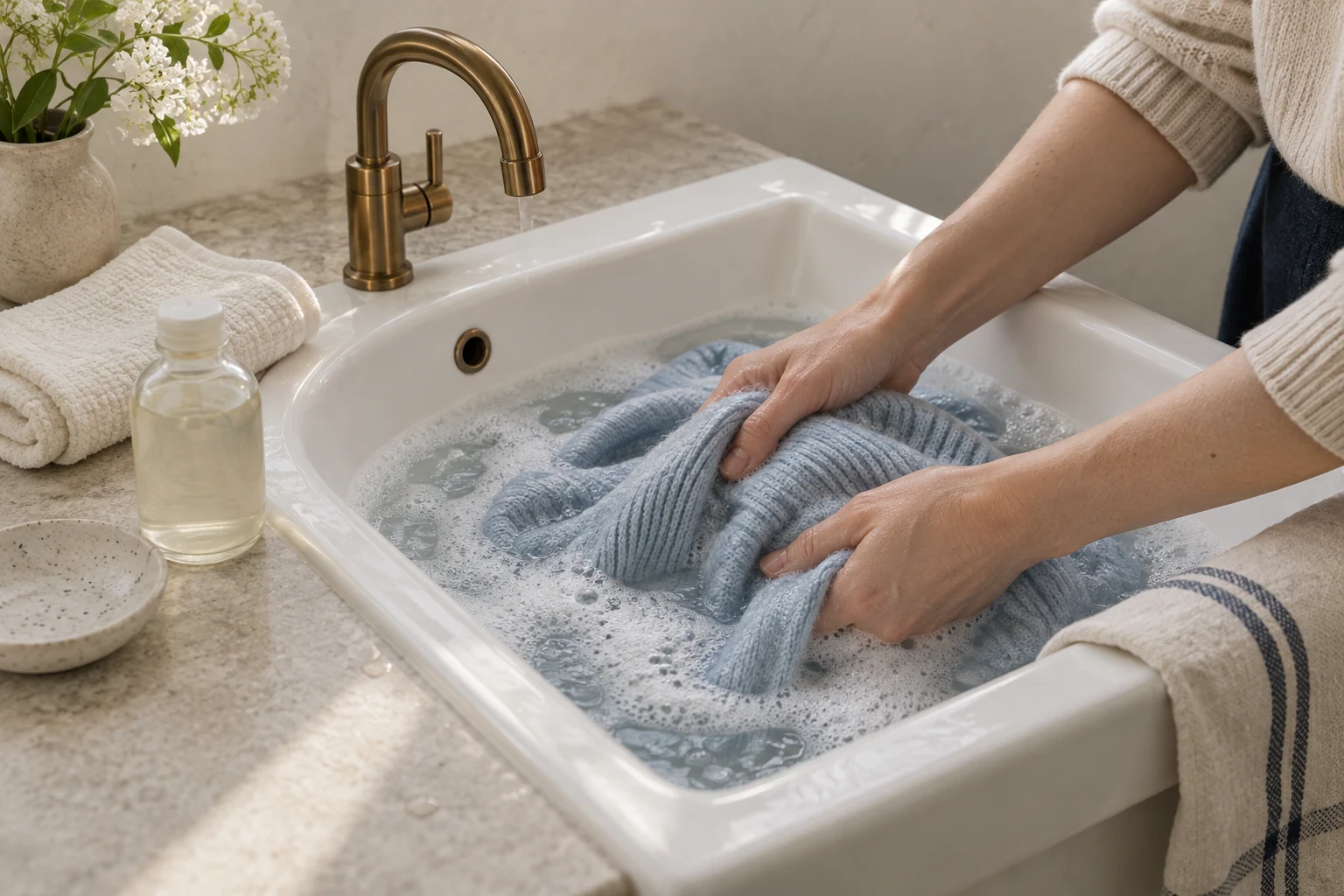
If the label asks for hand washing, or you only have an agitator top loader, use a clean bathtub and the same basic method as in our guide to hand washing clothes, scaled up. Fill it with water at the label temperature, dissolve the down wash, and press the jacket under until it is saturated. Knead it gently for a few minutes, paying attention to the collar and cuffs, then drain, refill with clean water and press repeatedly until no suds appear. Two or three rinses are usually needed.
Wet down is heavy, and lifting a sodden jacket by the shoulders can tear the internal baffle stitching. Press out as much water as you can while it lies in the empty tub, then gather it up from underneath in both arms. If your washer has a spin only setting, running it once will remove far more water than pressing alone.
Dry it slowly with dryer balls
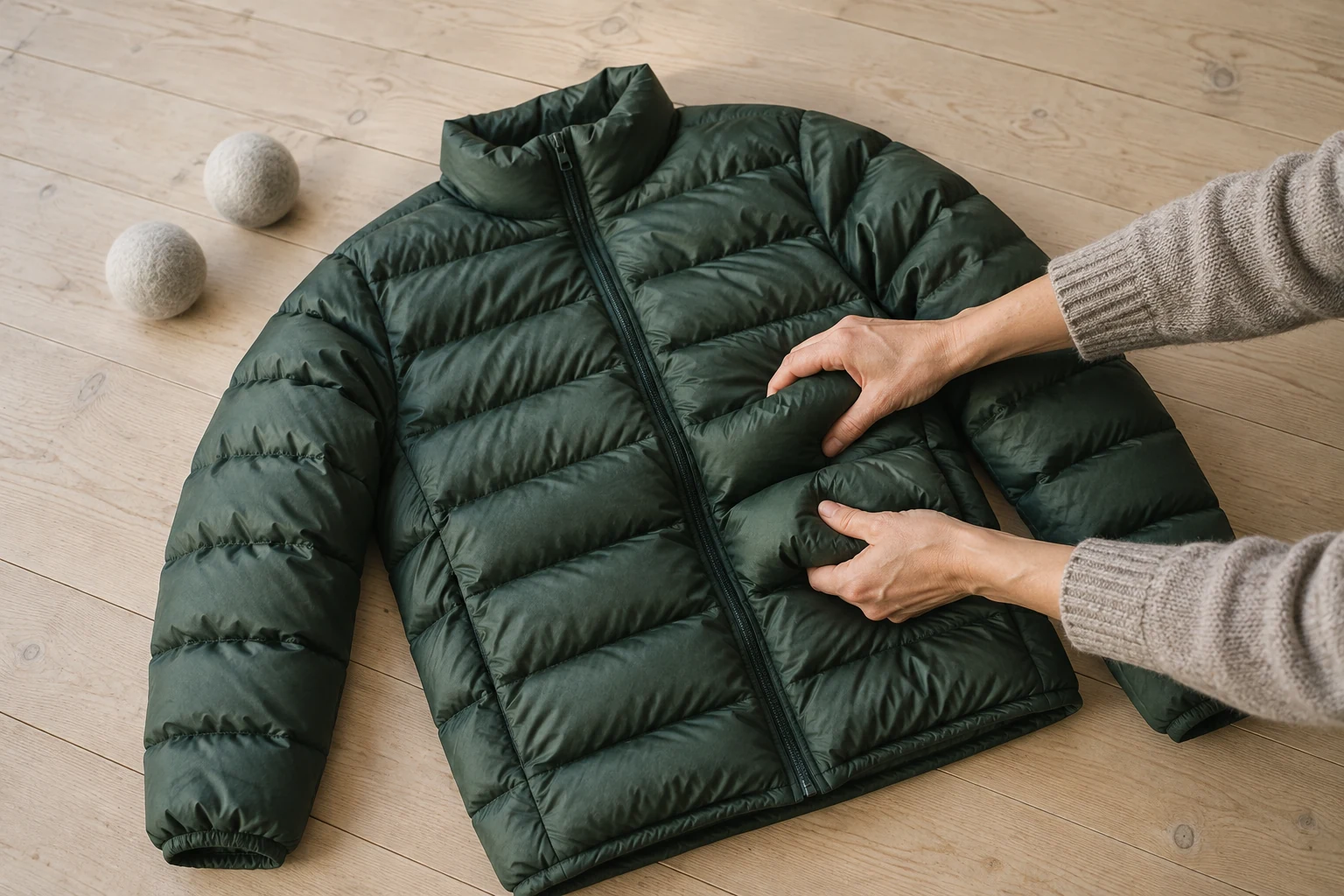
Drying is where the jacket either gets its loft back or ends up lumpy. Use the lowest heat setting. Arc'teryx recommends two dryer balls or clean tennis balls, which bounce against the jacket and break up clusters as they dry. If you worry about new tennis balls marking a pale shell, wool dryer balls, or tennis balls tucked inside clean white socks, do the same job.
Every 30 to 45 minutes, take the jacket out, turn it inside out or back again, and pull apart any lumps you can feel with your fingers, working the down back toward empty corners of each baffle. Arc'teryx warns that a down garment can take upwards of three hours to dry, and Nikwax notes it may need several cycles. Keep going until there are no clumps at all and the jacket feels evenly light. A jacket that seems dry outside can still be damp in the center of the thickest baffles, and down stored damp clumps and can develop mildew.
Air drying is possible if you have no dryer, but it is slow, often several days, and you need to shake the jacket and break up clumps by hand every few hours. Lay it flat or hang it somewhere warm and airy, away from direct heat, and finish with a short low tumble if you can. Our guide to air drying clothes has more on where and how to hang things indoors.
If it comes out clumpy, smelly or flat
Persistent clumps almost always mean the down is still wet or still holds detergent. Put it back in the dryer on low with the balls and keep breaking up lumps. If clumps return after it is fully dry, rinse the jacket again in plain water with an extra spin and dry once more. A musty smell after drying points to down that was left damp too long; wash and dry it again straight away, and see our guide on dealing with mildew in clothes if spots appear on the shell. For lingering odor without mildew, our guide to getting smells out of clothes has further options.
A few feathers working through the shell is normal. Pull a poking feather back in from the inside of the fabric rather than pulling it out, which enlarges the hole. Small tears can be closed with a repair patch made for outdoor fabrics. If rain no longer beads on the shell after washing, Arc'teryx suggests renewing the water repellent treatment with a product made for that purpose.
| Problem | Likely cause | Fix |
|---|---|---|
| Clumps | Down still wet or holding detergent | Keep drying low with balls, or rinse and spin again |
| Musty smell | Down left damp too long | Wash and dry again straight away |
| Feather poking through | Normal for down | Pull it back in from the inside |
| Rain no longer beads | Water repellent finish worn | Renew it with a product made for that |
Common mistakes
Using high heat to speed things up
High dryer heat can melt thin nylon shells and damage the down. Low heat and more time is the only way. If your dryer's low setting runs hot, check the jacket often and give it breaks outside the drum.
Storing it before it is completely dry
Damp down inside a closet or a stuff sack clumps and can smell or mildew within days. Squeeze the thickest baffles and the collar; if any part feels cool or heavy, it needs more time.
Keeping it compressed all summer
Down stays springier if it is stored loosely on a wide hanger or in a large breathable bag, not squeezed into its small stuff sack for months.
Questions people ask
Is a down jacket ruined if it gets wet?
No. Wet down collapses and insulates poorly while it is wet, but the clusters recover once they are dried thoroughly, which is exactly what happens in every home wash. The real risk is leaving it damp, which leads to clumps, smells and mildew. After a soaking in rain, hang it somewhere airy and then tumble it on low with dryer balls until it is fully dry.
How do I make my down jacket puffy again?
A flat jacket usually needs cleaning and a thorough dry, not a new jacket. Body oil and grime weigh the clusters down, so a wash with a down specific product followed by a long, low heat tumble with two dryer balls often restores much of the loft. If it is only compressed from storage, ten to twenty minutes on low with the balls, or a few hours hanging loosely, is often enough.
Can you dry clean a down jacket?
Only if the label says so. Most outdoor makers give home washing instructions instead, because harsh cleaning can strip the natural oils that keep down lofty. If you would rather hand it over, choose a cleaner that specifically offers down cleaning and ask how they dry it.
Can I use regular detergent on a down jacket?
It is not recommended. Ordinary detergents can strip the down's natural oils and leave residue that makes clusters stick together. A down specific wash is inexpensive compared with the jacket and rinses out cleanly.
How many dryer balls should I use for a down jacket?
Two is the usual recommendation, whether wool dryer balls or clean tennis balls. More does not dry the jacket faster, and fewer leaves more clumps for you to break up by hand.
Why does my down jacket smell after washing?
Usually the down was not fully dried or was dried too slowly in a cold, damp room. Wash it again with a down wash, spin it hard and dry it on low heat until every baffle is dry. The smell should go once the down is truly dry.
Sources and further reading
References used for this guide. Each opens the original page in a new tab.
Keep reading
Washing and ironing
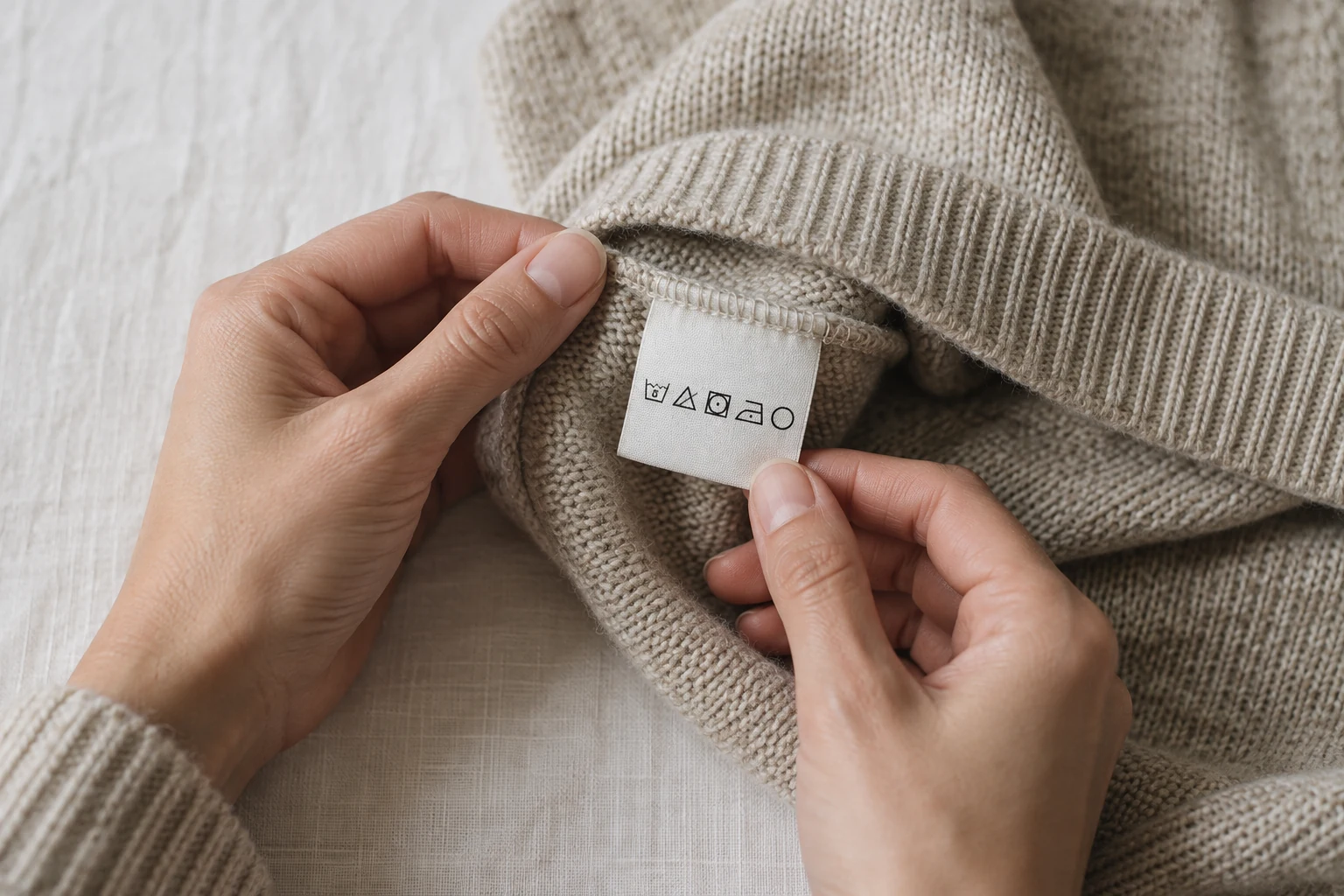
Laundry symbols explained: how to read a care label
What laundry symbols mean, in plain words: the wash tub, triangle, square, iron and circle, plus the dots, bars and crosses that change each instruction.
Washing and ironing
How to get smell out of clothes
How to get smell out of clothes, whether it is sweat, a musty washer smell or smoke: airing, better washing, careful use of baking soda and vinegar, and prevention.
Stain removal
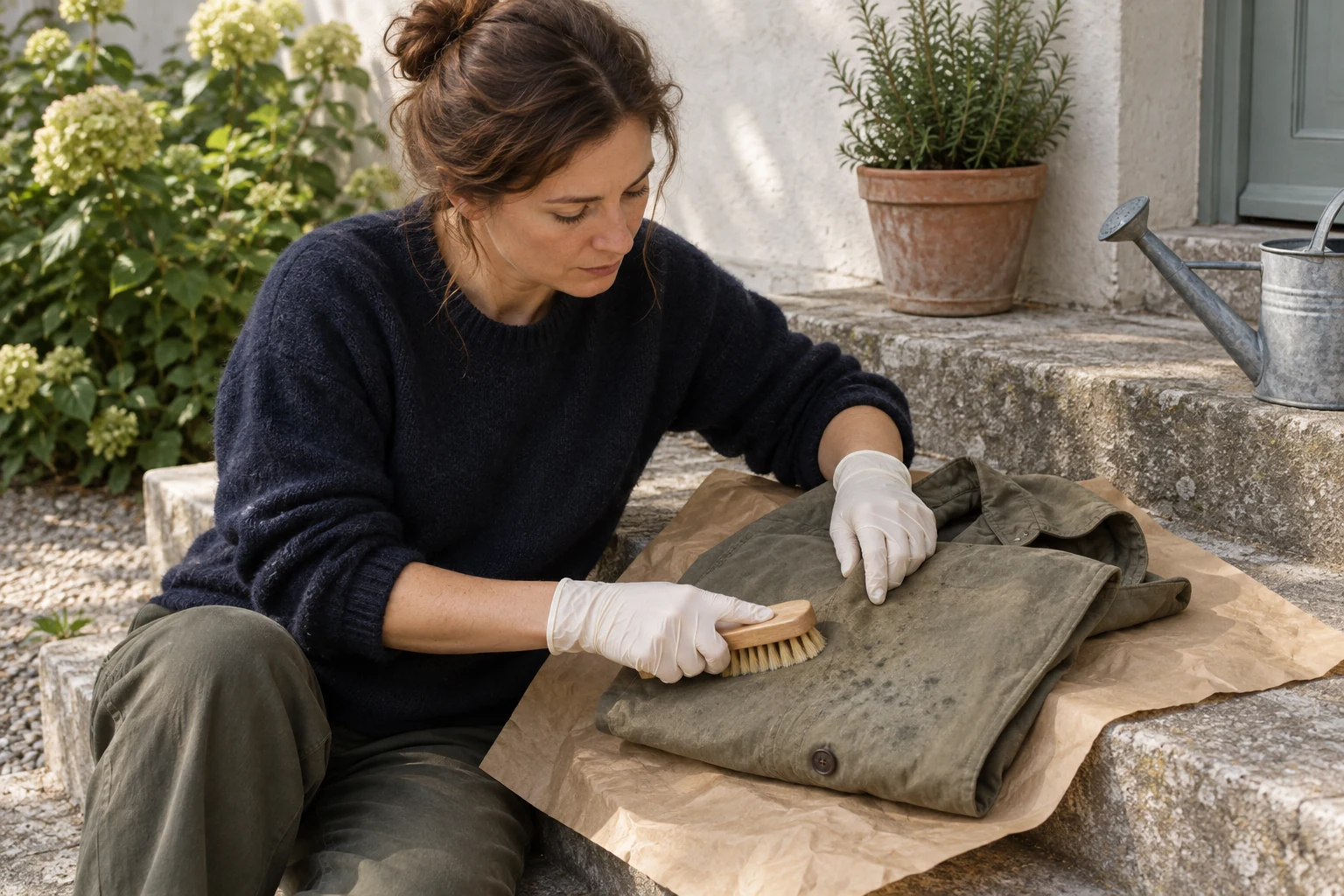
How to remove mold from clothes
Remove mold and mildew from clothes safely: brush it off outdoors, wash hot with the right bleach, treat leftover stains, and keep it from coming back.

Weather
What to wear in 40 degree weather
At 40°F the wind and the rain matter as much as the number. How to layer, what to wear on your neck, hands and feet, and outfits for every hour outside.
Washing and ironing
How to hand wash clothes properly
How to hand wash clothes in a sink or basin: which detergent to use, water temperature by fabric, how long to soak, how to rinse and how to dry without stretching.