1950s fashion for men and women: what people wore
In this guide
A sock hop birthday, a diner themed party, a swing dance class, or simple affection for a full skirted dress with a neat cardigan: all of them lead back to the same decade. The fashion of the 1950s is among the most recognizable styles of the last century, and one of the easiest to wear today, because its best shapes were designed around a defined waist and practical everyday fabrics.
This guide covers what women and men actually wore in the fifties, from office to weekend, what to put together for a 50s party, and how to bring the style into a modern wardrobe without looking like you stepped off a film set.
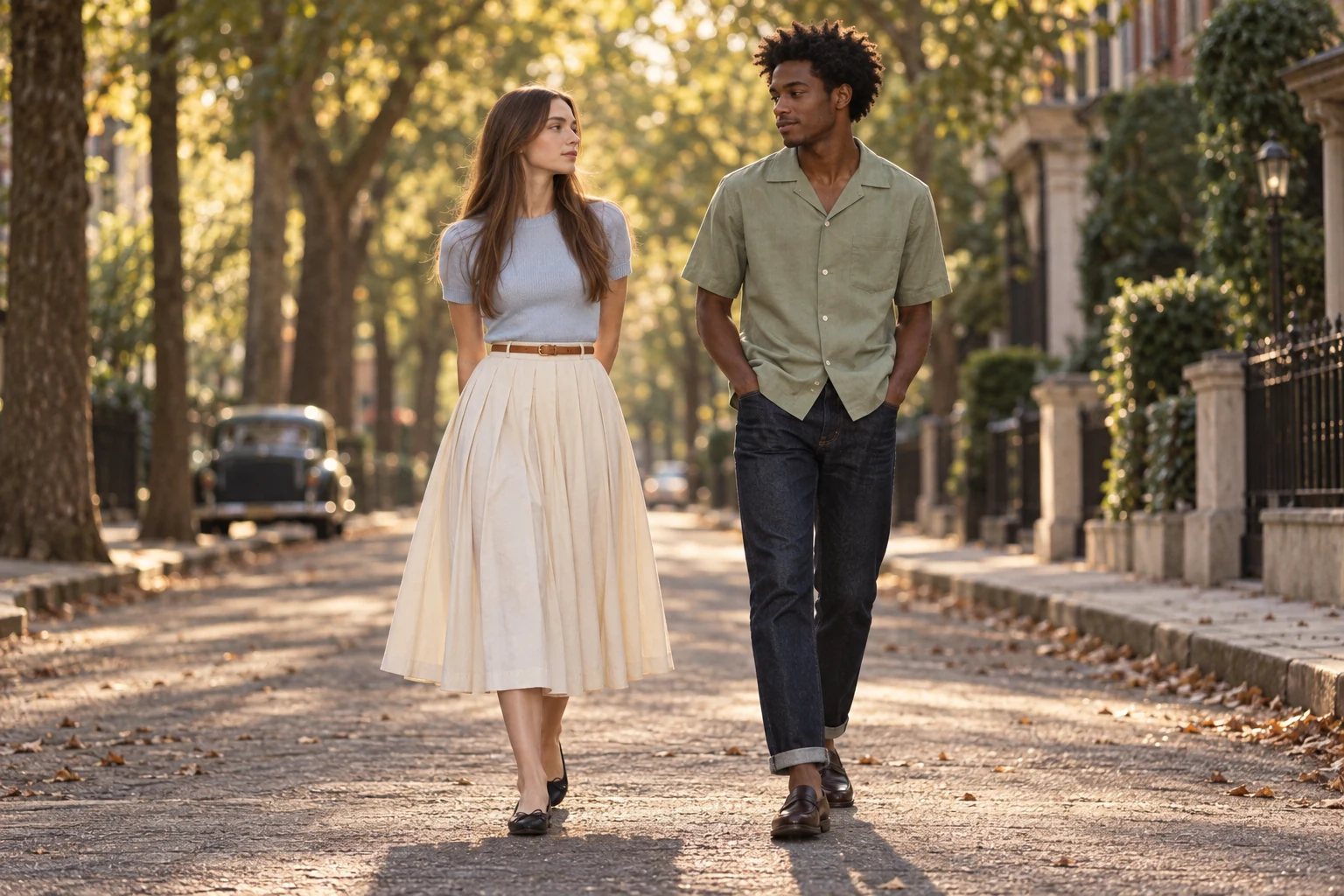
The shape of 1950s fashion
The decade's women's fashion really begins in February 1947, when Christian Dior showed his first collection in Paris. The press named it the New Look: a nipped in waist, soft rounded shoulders, padded hips and a long, very full skirt, a deliberate break from the boxy, fabric rationed clothes of the war years. The Fashion Institute of Technology's timeline notes that this full skirted silhouette dominated the early 1950s, with tiny corseted waists and softened shoulders through the middle of the decade.
At the same time a second shape ran alongside it: the slim sheath dress and the pencil skirt, fitted closely over the hips and narrowing toward the knee. Late in the decade designers loosened the waist altogether. Cristóbal Balenciaga's high waisted chemise and the sack dress of 1957 hung straight from the shoulders, and Coco Chanel's reintroduced straight cut suit, from 1954 onward, favored the natural body over corsetry. These easier shapes lead directly into the shift dresses of 1960s fashion for women.
1950s fashion for women
The everyday workhorse was the shirtwaist dress: a buttoned bodice like a shirt, a collar (often a rounded Peter Pan collar), short or elbow sleeves, and a skirt that was either full or straight, always finished with a matching belt. Full skirts were held out by stiffened petticoats of nylon net, which is why a 1950s swing dress in photographs stands out so far from the legs. Cotton prints, gingham, polka dots and small florals were typical in summer; wool and wool blends in plain colors and plaids for cooler months.
Separates were just as important, especially in American sportswear, which designers such as Claire McCardell had made respectable. Matching twin sets of a cardigan and pullover were worn with pencil or full skirts. Fitted calf length capri pants and slim pedal pushers were worn for leisure. Teenagers adopted the felt circle skirt, sometimes appliquéd with a poodle, with ankle socks and saddle shoes, which became one of the decade's best known fads.
Grooming and accessories were part of the outfit, not an afterthought. Women were expected to be carefully turned out, with gloves, a hat, a structured handbag and shoes coordinated in color. Stiletto heels, reinforced with a thin metal rod, appeared around the middle of the decade, while flats and low heels stayed common for daytime. Cocktail dresses emerged as a new category between day and full evening wear, which is why our guide to cocktail attire for women still leans on 1950s shapes.
1950s fashion for men
Office wear for men was dominated by the gray flannel suit, so common that a 1955 novel, The Man in the Gray Flannel Suit, used it as shorthand for corporate conformity. Early in the decade suits kept the full, roomy cut of the 1940s. Through the decade the Ivy League look spread from college campuses: a single breasted jacket with natural, lightly padded shoulders, notched lapels, straight trousers, a button down oxford cloth shirt and a narrowing tie, the root of what is now called preppy style. Fedoras were still worn with suits, with narrower brims than before.
Casual clothing for men and teenage boys changed faster. Films such as The Wild One (1953), starring Marlon Brando, and the screen image of James Dean turned blue jeans, a white T shirt and a leather jacket into a symbol of youth. Hawaiian shirts, popular since the late 1940s, stayed a leisure favorite, alongside knitted cardigans and short sleeved shirts with open collars. In Britain, working class Teddy Boys wore long velvet collared jackets with narrow trousers, a very different kind of 1950s fashion for guys.
| Setting | Women | Men |
|---|---|---|
| Day and office | Shirtwaist dress with a matching belt, or a twin set with a pencil skirt | Gray flannel suit or Ivy League jacket, button down oxford shirt, narrow tie |
| Leisure | Capri pants, pedal pushers, and felt circle skirts with saddle shoes | Hawaiian shirts, knitted cardigans and open collar short sleeved shirts |
| Youth rebel | Cuffed jeans, a fitted top and a scarf in the hair | Blue jeans, a white T shirt and a leather jacket |
| Finishing touches | Gloves, a hat, a structured handbag and shoes coordinated in color | A fedora with a narrower brim than before |
Late in the decade the chemise and the sack dress loosened the waist and pointed toward the 1960s.
What to wear to a 50s party
For women, the quickest 1950s outfit is a fitted top with a full skirt that reaches just below the knee. That might be a swing dress in polka dots or gingham, or a fitted knit tucked into a circle skirt with a wide belt at the natural waist. A petticoat underneath adds volume but is optional. Finish with a small cardigan over the shoulders, flat Mary Janes or low heels, a neck scarf tied at the side, and red lipstick. For a greaser or rockabilly look, cuffed jeans, a fitted top and a scarf in the hair work just as well.
For men, choose between two clear looks. The clean cut version is gray or tan trousers, a button down shirt or a short sleeved knit polo, a cardigan or crew neck sweater, and loafers. The rebel version is dark straight jeans with a turned up hem, a plain white T shirt, a leather or denim jacket and boots, with the hair combed back. Our guides to cuffing jeans and tucking in a shirt help both versions look deliberate.
Make a 50s outfit from clothes you already own
You probably own more 50s style clothing than you think. Any full or pleated midi skirt, a fitted short sleeved top or thin sweater, a narrow belt and simple flats will give you the shape; add a silk scarf at the neck and you have a convincing day look. A plain shirt dress, belted at the waist, is essentially a shirtwaist. For men, straight dark jeans, a white T shirt and a jacket, or chinos with a tucked in oxford shirt and loafers, already read as fifties.
The detail that sells it is the waist. Fifties clothes sat at the natural waist, higher than most modern jeans and trousers. Tuck tops in, belt dresses and skirts at the narrowest point of your torso, and choose high rise bottoms where you can. Hair helps too: a side part and a little volume for women, a neat short cut combed back for men.
How to wear 1950s style today
In everyday clothes, the fifties survive best as individual pieces. A full midi skirt with a plain T shirt and sneakers, a belted shirt dress, cropped slim trousers with ballet flats, or a boxy cardigan with jeans all carry the decade's feeling while looking current. For men, a camp collar shirt, straight leg jeans, a suede jacket or a gray flannel suit worn with a knit tie borrow cleanly from the period.
Vintage 1950s dresses do exist in good condition, but original sizes run small compared with modern labels and are cut for the foundation garments of the time, so compare actual measurements rather than the size on the tag. Our guide to measuring yourself for clothes shows where to measure bust, waist and hips. Reproduction dresses cut for modern bodies are easier to wear and to wash, and they give the same silhouette.
Questions people ask
What is the difference between a swing dress and a pencil dress?
A swing dress has a fitted bodice and a very full skirt that moves when you walk or dance. A pencil or sheath dress follows the body over the hips and narrows toward the knee. Both were worn throughout the 1950s, and both mark the natural waist.
Do I need a petticoat for a 1950s dress?
Not unless you want the dramatic volume of period photographs. Most full skirted dresses hang well on their own. A petticoat of net under the skirt adds bounce and is worth it for dancing or a themed party, but it is rarely needed for everyday wear.
What did teenage boys wear in the 1950s?
Clean cut boys wore chinos or flannel trousers, button down shirts, sweaters and loafers, often modeled on college students. Others copied film rebels with jeans, white T shirts and leather jackets. Both looks are easy to recreate today for a party or a school project.
How is 1960s fashion different from 1950s fashion?
The fifties defined the waist and emphasized a curved, grown up figure. By the mid 1960s the waist had largely disappeared into straight shift dresses and much shorter skirts, and youth rather than maturity set the tone. The late fifties chemise and sack dresses are the bridge between the two.
Sources and further reading
References used for this guide. Each opens the original page in a new tab.
Keep reading
Styles
1920s fashion for men and women: what people wore
What 1920s fashion really looked like for women and men, from flapper dresses to Oxford bags, plus what to wear to a Gatsby party and how to borrow the style today.
Styles
Preppy style: what it is and how to wear it now
What preppy style means, where it came from, the core pieces for men and women, and how to wear modern preppy outfits without looking like a costume.
Dress codes
Cocktail attire for women: what to wear
What cocktail attire means for women: dress lengths, fabrics, jumpsuits and tailored sets, shoes and bags, and how the invitation, venue and season change it.
Everyday style
How to cuff jeans: single, double and pinroll
How to cuff jeans neatly: single, double, pinroll and Japanese cuffs, which jeans and shoes each one suits, and when to hem instead of rolling.
Everyday style
How to check dress fit, from shoulders to hem
How to check dress fit in a fitting room or at home: what to look for at the shoulders, bust, waist, hips and hem, how to read wrinkles, and what a tailor can fix.