Suit button rules: which buttons to fasten
In this guide
Top button, both buttons, the middle one? The question tends to arrive at the worst moment, as you stand to walk into a meeting, a ceremony or an interview and your hand goes to the front of your jacket. The suit jacket button rules can sound like arbitrary etiquette, but almost all of them come from how the jacket is cut. Once you see that, you will not need to memorize much.
The quick version comes first, then the reasons, then the cases that confuse people: three button jackets whose lapel rolls over the top button, double breasted suits, sitting down, and waistcoats.
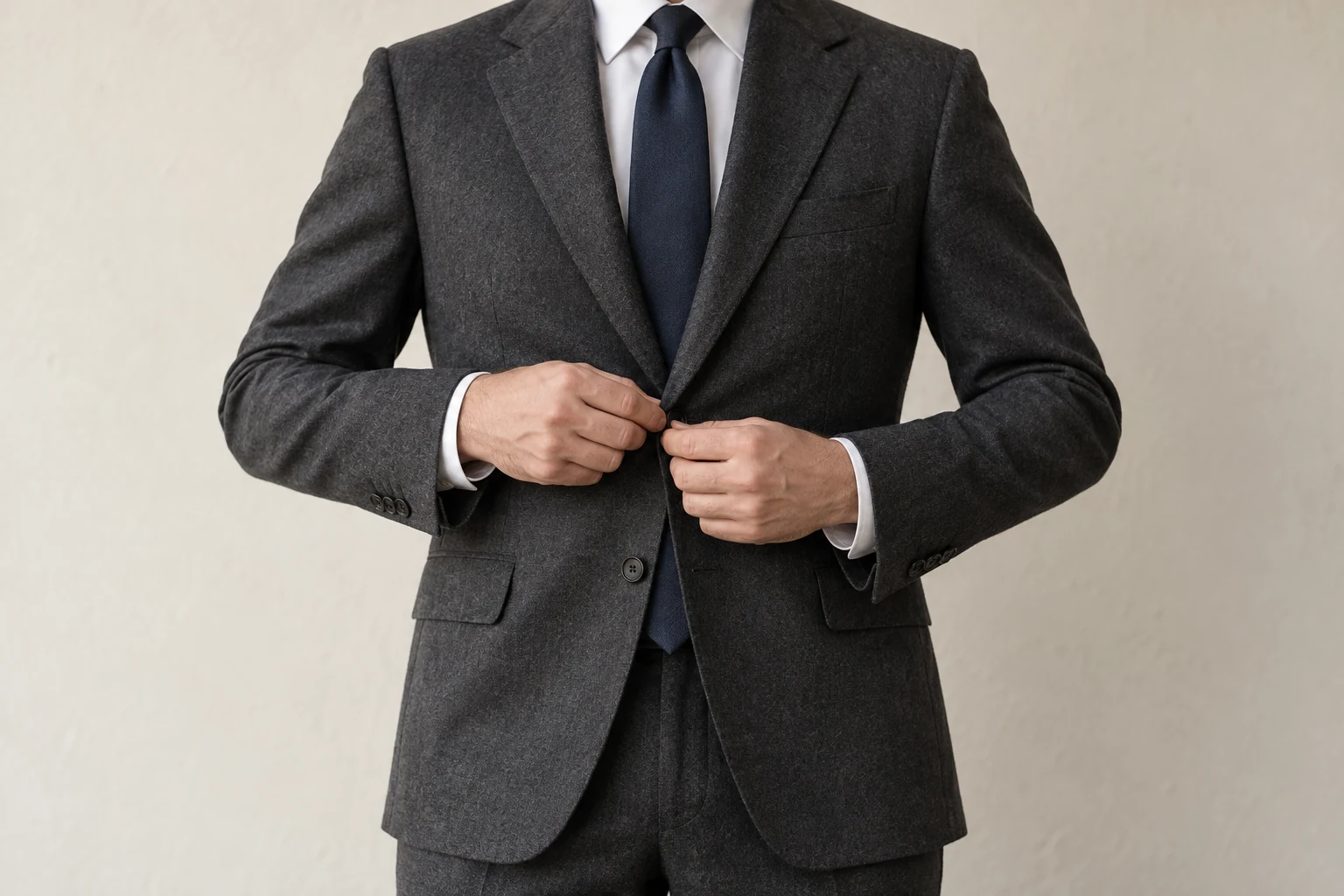
Suit jacket button rules at a glance
On a single breasted jacket, the buttons you fasten are the ones at or above your natural waist, and the bottom button stays open. That gives you three everyday cases. A one button jacket is fastened when you stand. A two button jacket is fastened at the top button only. A three button jacket follows the old phrase sometimes, always, never: the top button is optional, the middle is always fastened, and the bottom is never fastened.
Two more rules cover most situations. Unbutton a single breasted jacket when you sit down, and fasten it again when you stand, for example to greet someone or walk to the front of a room. A double breasted jacket is different: it is designed to stay closed, standing and usually seated, with its inside anchor button fastened too. These are conventions of classic American and British tailoring, repeated by most menswear guides, and they apply equally to suit jackets, blazers and sport coats.
| Jacket | Standing | Seated |
|---|---|---|
| One button | Fastened | Open |
| Two button | Top only | Open |
| Three button | Middle, top optional, bottom never | Open |
| Three roll two | Middle only, lapel rolls over the top | Open |
| Double breasted | Working button plus inside button | Usually fastened |
| With a waistcoat | Jacket often left open | Open |
Double breasted suits: keep them closed
A double breasted suit has two overlapping front panels and two columns of buttons. Only some of the buttons work; the rest are there for symmetry. Unlike a single breasted jacket, it is meant to be worn fastened almost all the time, because when it is open the wide panels flap loosely and look untidy.
On the most common style, six buttons with two that fasten, close the working button at your waist, which is usually the middle button of the outer row. The traditional approach fastens the lower working button as well, while many people now leave the bottom button open for a cleaner V; either is correct if the jacket was cut for it. Inside the jacket there is usually a hidden button, sometimes called the anchor or jigger button, that holds the underneath panel in place. Fasten it, or the inside panel will droop and pull the front out of line.
Double breasted jackets usually stay fastened when you sit, too, since that is what keeps them neat. If one is tight enough across the stomach that it pulls when you sit, you can open it, but that is a hint to have the waist looked at.
Sitting down, waistcoats and tuxedos
When you sit in a single breasted jacket, unbutton it. A fastened jacket bunches at the chest, pulls at the button and wrinkles the fabric, and the open jacket falls to the sides naturally. Fasten it again as you stand. In an interview, that simple motion when you rise to shake hands is one of the details people notice without knowing why.
A three piece suit changes the picture slightly. With a waistcoat underneath, many men leave the jacket open entirely, since the waistcoat already provides the clean line. The waistcoat itself, as our guide to wearing a waistcoat explains, traditionally has its bottom button left open, as long as it is cut with points at the hem. For evening wear the conventions differ: a one button tuxedo jacket is usually fastened when standing, while formal evening waistcoats are often cut to close fully. Our guides to the difference between a suit and a tuxedo and the black tie dress code cover evening clothes in more detail.
Overcoats are the practical exception to all of this. They are made for warmth, so fasten as many buttons as you need, and leave the bottom open only if you want more room to stride.
Common mistakes
Fastening every button on a single breasted jacket
It pulls the curved fronts across your hips and makes the jacket crease and ride up. Leave the bottom button open, whatever the button count.
Forcing the top button on a three roll two
If the lapel is cut to roll over the top button, fastening it flattens the roll and leaves a crease. Fasten the middle button and let the lapel fall.
Sitting in a fastened single breasted jacket
The jacket bunches at the chest and strains the button, and over a long dinner it creases the cloth. Unbutton as you sit and rebutton as you stand.
Leaving a double breasted jacket open
An unbuttoned double breasted jacket flaps and looks unfinished. If it is too tight to keep closed comfortably, the answer is alteration or a different jacket.
Questions people ask
Do you button the bottom button on a suit?
Not on a single breasted suit. Modern jackets are cut with the fronts curving open below the waist button, so fastening the bottom one causes pulling and creases. On a double breasted jacket the working buttons follow different rules, and fastening the lower one is a traditional option.
Do blazer button rules differ from suit rules?
No. Blazers and sport coats follow the same conventions: top button on a two button, middle on a three button, bottom never, and unbutton when you sit. Casual unstructured jackets are often worn open, which is fine in business casual settings.
Should a suit jacket be buttoned when standing?
In formal settings, yes: when you stand to speak, meet someone or pose for a photo, fasten the top or middle button. Walking around a relaxed event with the jacket open is common and acceptable, especially outdoors or in warm weather.
Why does my jacket pull when I button it?
Creases radiating from a fastened button usually mean the jacket is too tight at the waist, or that you have fastened the wrong button. Try the correct button first; if the pulling remains, a tailor may be able to let the waist out slightly.
Is it okay to wear a suit jacket that does not button?
If it is a suit jacket that cannot close at the waist button without straining, it is too small, and wearing it open only hides the problem until you need to fasten it for a photo or a handshake. Ask a tailor whether the waist can be let out, or size up. Unstructured casual jackets and some cardigan style blazers are meant to be worn open, and those are fine as they are.
Sources and further reading
References used for this guide. Each opens the original page in a new tab.
- The Art of Manliness: the sometimes, always, never three button rule Opens in a new tab
- Gentleman's Gazette: how to button suits, jackets, vests, overcoats and tuxedos Opens in a new tab
- He Spoke Style: how to button a suit jacket, including double breasted Opens in a new tab
- Mental Floss: the origin story of the sometimes, always, never rule Opens in a new tab
Keep reading
Suits and tailoring
How a suit should fit: shoulders, sleeves and length
How should a suit fit? Check the shoulders, collar, button, jacket length, sleeves and trousers in the mirror, and learn which problems a tailor can and cannot fix.
Suits and tailoring
Suit vs tuxedo: how to tell them apart and which to wear
Suit vs tuxedo explained: the satin lapels, trouser stripe and bow tie that set a tuxedo apart, and which one a wedding, prom or black tie invitation asks for.
Dress codes
What to wear to a job interview
What to wear to a job interview: how to read the company, dress one step above daily wear, outfits for men and women, video interviews and what to avoid.
Dress codes
Business casual for men: what to wear to work
What business casual means for men at work, with outfit formulas, the right shoes, when jeans are allowed and how to read your own office's version of the code.
Dress codes
Black tie attire: what to wear, for men and women
Black tie attire explained: the tuxedo in detail, the shirt, bow tie and shoes, plus gowns and elegant alternatives for women and black tie weddings.